Australian Online Pokies: Legal and Safety Guide
 Available in AU

A practical guide to Australian legal limits, payment checks, bonus terms, free-play rules and the limits of RTP comparisons.
Table of Contents
- The legal position for Australian players
- Real-money play: deposits, withdrawals and the risks in between
- PayID transfers: what the method does—and does not—tell you
- No-deposit offers and the conditions behind them
- Free play and free spins: know what can be withdrawn
- Signup bonuses: calculate the wagering before you accept
- Using a phone: browser access, apps and safer limits
- How online pokies work: randomness and RTP settings
- Assessing a site when Australian recourse is limited
- New pokies and the limits of return comparisons
- Pokies Regions
The legal position for Australian players
Australia’s rules draw a sharp line between the businesses offering online pokies and the people who play them. Under the Interactive Gambling Act 2001, a company cannot provide real-money online pokies to people in Australia without a domestic licence. No such licences have been issued, so there is no Australian-licensed online casino.
That prohibition is directed at operators, not individual players. An Australian who chooses to play on an offshore site that accepts them is not committing an offence under this law. The distinction matters: the legality of a provider’s offer and the legal position of a customer are not the same thing. It also does not mean that offshore sites are approved or supervised by Australian authorities.
The Australian Communications and Media Authority (ACMA) enforces the Act. It can block access to offshore gambling sites it identifies as illegal, and internet service providers must comply with its blocklist. A site being accessible at a particular moment is not proof that it has an Australian licence or that Australian regulators oversee its operations. Access can also be affected by blocking, so availability should not be confused with domestic authorisation.
Choosing an online pokies site in Australia means checking the details that matter to you before you play. Use this list as a reference point and review each operator’s available information.
1. LuckyVibe
License: Curacao Gaming Control Board OGL/2023/176/0095 (Hollycorn N.V.) LuckyVibe is listed with a Curacao Gaming Control Board licence, OGL/2023/176/0095, held by Hollycorn N.V. This gives you a specific licensing detail to consider.
2. Golden Pokies
License: Curacao Golden Pokies is listed as operating under a Curacao licence. That is the available detail to consider when reviewing this operator.
3. Vegaz Casino
License: Curacao OGL/2024/1335/0780 · Min. deposit: EUR 20 Vegaz Casino lists Curacao licence OGL/2024/1335/0780 and a minimum deposit of EUR 20. You can use these details when deciding whether its entry requirements suit you.
4. Bizzo Casino
License: Curacao Gaming Control Board (TechSolutions Group N.V.) Bizzo Casino is listed with a Curacao Gaming Control Board licence, with TechSolutions Group N.V. named. This provides a specific licensing detail for your review.
5. DragonSlots Casino
License: Curacao Gaming Authority (Jumpman Gaming Ltd) DragonSlots Casino is listed under the Curacao Gaming Authority, with Jumpman Gaming Ltd named. You can factor this licensing information into your consideration.
6. Kingmaker
Payout speed: crypto ~90 minutes, fiat 1-5 days · Min. deposit: A$30 Kingmaker lists a minimum deposit of A$30, with crypto payouts taking about 90 minutes and fiat payouts 1–5 days. These deposit and payout details can help you assess whether its payment options fit your needs.
7. Uptown Pokies
License: Curacao (operating since 2017) · Min. deposit: A$20 Uptown Pokies is listed as operating since 2017 under a Curacao licence, with a minimum deposit of A$20. You can consider both its stated operating history and entry amount.
8. GoldenCrown
License: Curacao Gaming Control Board OGL/2023/176/0095 (Hollycorn N.V.) GoldenCrown is listed with Curacao Gaming Control Board licence OGL/2023/176/0095, held by Hollycorn N.V. This gives you a specific licensing detail to review.
9. Wild Tokyo
License: Curacao · Payout speed: crypto 30-60 minutes, fiat 1-5 days · Min. deposit: A$10 Wild Tokyo lists a Curacao licence and a minimum deposit of A$10. Its stated payout times are 30–60 minutes for crypto and 1–5 days for fiat, details you can weigh when choosing a payment method.
10. Ricky Casino
Payout speed: crypto under 1 hour, PayID 1-3 business days · Min. deposit: A$20 (A$30 to qualify for the bonus) Ricky Casino lists a minimum deposit of A$20, or A$30 to qualify for the bonus. Its stated payout times are under an hour for crypto and 1–3 business days for PayID.
For players, the lack of local licensing has practical consequences. If an offshore operator refuses to pay winnings, Australian players have no legal recourse in Australia. The law’s focus on operators does not create a local complaints process or a domestic regulator that can resolve an individual payment dispute with an offshore business. That is a less comfortable position than playing with a locally licensed provider; there are none for online casinos here.
BetStop has a separate, narrower role. It is Australia’s self-exclusion register, but it applies only to Australian-licensed operators. Because no Australian-licensed online casino exists, BetStop does not bind offshore pokies sites. Registering with the service should not be treated as a way to block access to those sites or as a substitute for checking what controls an offshore operator actually offers.
This legal background is worth keeping in mind when considering Australian pokies online. A site may accept Australian customers, but that does not make its service locally licensed, give it Australian regulatory oversight or guarantee that a dispute can be resolved here. “Available to Australians” describes access, not the level of protection.
The same distinction helps separate legal status from other details a site may display. A payment option or a statement about games does not establish that the operator has Australian authorisation. Those details need to be assessed on their own terms, while the central limitation remains: there is no domestic licensing framework for real-money online pokies and no Australian-licensed online casino.
Casino in Adelaide: Hotel, Dining and Visitor Guide
So, the legal position is not that Australians are prohibited from playing offshore. The law prohibits companies from offering these services to people in Australia without a domestic licence, while the player is not targeted by that prohibition. But an offshore site operates outside Australian casino licensing, and local protection is correspondingly limited. That is the context for weighing practical issues such as moving money and assessing a site before deciding whether to use it.
Real-money play: deposits, withdrawals and the risks in between
A deposit is not simply the amount shown on the payment screen. The sum that leaves your account can be affected by the operator’s minimum, your bank’s treatment of the transaction and any conditions attached to withdrawing funds. For anyone considering real-money play on an offshore site, those details matter before money is sent: a successful deposit does not establish that a later withdrawal will be straightforward.
A specialist review reports that many operators set minimum deposits between AU$10 and AU$20, while some accept AU$5. These are reported figures, not a promise about any particular site. Check the payment screen and the terms that apply to the selected method before proceeding. A minimum deposit is only the entry point; it does not tell you about possible bank charges, withdrawal limits or the documents required to receive a payout.
Your bank may decline the payment—or classify it differently
Australian banks and card companies are increasingly blocking transactions to gambling sites identified as such, according to a specialist review. A card payment that fails may therefore reflect the issuer’s decision rather than a technical fault at the receiving end. Do not assume that trying again, or switching to another payment route, will resolve the issue; your bank can explain how it treats the transaction and what restrictions apply.
Attention: A bank or card issuer may classify a gambling deposit as a cash advance, potentially triggering a 3–5% fee and immediate interest.
There is also a cost risk even when a card deposit goes through. A specialist review warns that a bank or card issuer may classify a gambling deposit made by credit or debit card as a cash advance. In that case, a fee of 3–5% may apply and interest may begin immediately, rather than being treated like an ordinary purchase. The precise treatment depends on the issuer and the transaction. Check your card terms or contact the issuer before making a payment; the amount displayed by a site may not include charges added by your financial institution.
If a payment is declined, avoid repeated attempts without understanding why. Multiple tries do not change the issuer’s rules, and they can make it harder to track which transactions were authorised, pending or reversed. Keep a record of any transaction reference and check your bank statement rather than relying only on the site’s balance display.
Withdrawal limits can affect access to winnings
The amount shown as a balance is not necessarily the amount you can receive at once. A specialist review reports that some casinos impose weekly or monthly withdrawal caps between $5,000 and $10,000. Its illustration is a $50,000 jackpot potentially being paid in instalments over a period of years. The figures describe a reported possibility, not a standard that applies everywhere. The practical point is to read the withdrawal rules before depositing: a cap can determine how quickly funds are released even if a payout is approved.
Look for the rules covering withdrawal frequency, maximum amounts, the payment route and any requirement to withdraw through the method used to deposit. Check whether the terms distinguish between a requested withdrawal and one that has been approved. Do not treat a stated processing estimate as a guarantee that money will arrive by a particular date; the bank or payment provider may also affect the transfer.
Fast payout online casinos in Australia: what to check
Keep copies of the relevant terms and transaction records. If the amount credited does not match what you expected, or a withdrawal is delayed, those records can help you identify whether the issue concerns the operator’s rules, a bank decision or a payment-processing step. They cannot ensure a dispute will be resolved, but relying on memory alone makes a money problem harder to examine.
Complete checks before asking for a payout
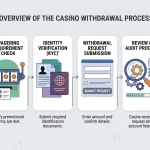
A specialist review says casinos commonly require identity checks before a first withdrawal. These may involve a photo of your identity document, proof of your residential address and, in some cases, a selfie holding the document. Requirements vary, so confirm what is needed and how documents must be submitted.
Complete identity and address verification before your first withdrawal, not after you have built a balance and are ready to cash out. Make sure your account details are accurate and that the documents are legible and current. If a site asks for additional information, use only its stated secure submission process; do not send identity documents through an unverified channel.
Verify Account Details
- Confirm account details are accurate
- Ensure identity documents are legible and current
- Verify residential address proof is up to date
- Use only the site’s stated secure submission process
Verification can be an ordinary compliance step, but it can also become a point of delay if the submitted material is incomplete or the details do not match. That is why the timing matters: the first withdrawal is a poor moment to discover that an address document is unacceptable or an account detail needs correction. Before transferring funds, consider whether you are comfortable with the site’s document requirements, payment conditions and withdrawal limits together. A low minimum deposit does not make those other terms less important.
PayID transfers: what the method does—and does not—tell you
PayID is not a separate bank account or a guarantee that a payment will go through. It is an alias system connected to Australia’s New Payments Platform (NPP): a transfer can be directed using an email address, mobile number or Australian Business Number (ABN), rather than entering the recipient’s bank account details. The money still moves between bank accounts.
The NPP is supported by all major Australian banks and uses end-to-end encryption. That describes the payment network, not every part of a transaction. A transfer can still be declined, delayed or unavailable because of a bank’s controls, the payment details supplied or the receiving service’s arrangements. Encryption should not be read as a promise that a particular recipient is legitimate or that a payment can be reversed if something goes wrong.
To make a PayID transfer for real-money play at an online casino, you need to link your PayID to a bank account first. The alias is a way to address a transfer; it does not hold funds independently. Before authorising any payment, check the recipient details shown by your banking service and make sure you understand what the transfer is for. A familiar-looking payment method does not make an unfamiliar recipient trustworthy.
There is also a practical complication: banks can restrict gambling-related transactions. A specialist review reports that some Australian banks, including members of the Big Four, sometimes block PayID transfers to gambling merchants they recognise. That is a reported practice, not a guarantee that a particular bank will block every such transfer—or allow one. Decisions can depend on the bank’s controls and the merchant details it identifies. If a transfer is declined, do not assume that repeatedly trying the same payment will solve the problem; check with your bank through its official channels.
Live casino online in Australia: access and protections
PayID availability is only a detail about how a site accepts payments. It does not establish that the operator is licensed, that a game is fair or that its return-to-player (RTP) figure—the stated share of stakes a game is designed to return over time—is transparent. In Australia, no domestic online-casino licences have been issued. A payment option cannot fill that gap or provide the protections a local licence would represent. Nor does PayID support show that a site’s published game information is complete or that a transfer will be returned if there is a dispute.
A specialist affiliate review describes PayID as being treated in the same way as other qualifying deposit methods at the sites it covers. That is a description from a particular kind of review, not a dependable rule for every operator or a permanent feature of the market. Payment terms can vary, so read the relevant cashier instructions and terms before deciding whether to proceed. Do not infer that a site accepts a method for withdrawals simply because it lists that method for deposits.
PayID is also distinct from PayPal. The fact that a site lists one payment option does not establish that it accepts another, or that either option is available for every account or transaction. Check the actual payment choices and conditions presented to you rather than relying on a general label or an old description.
Keep the role of each safeguard clear. BetStop applies to Australian-licensed operators and does not bind offshore sites; PayID does not extend BetStop’s reach. A bank transfer can move money, but it is not a gambling-control tool and does not verify an operator on your behalf. If you use BetStop, do not treat the presence of PayID as a way around its limits—or as evidence that an offshore service is covered by it.
In short, PayID tells you how a transfer may be addressed and which payment network carries it. It does not answer the more consequential questions about who receives the money, what protections apply or what happens if a dispute arises. Those questions need to be considered separately from the convenience of using an alias.
Big Red Pokies Online in Australia: Free Play Guide
No-deposit offers and the conditions behind them
A no-deposit offer is presented without requiring you to make an initial deposit. It may take the form of a bonus or free spins, sometimes accessed through a code. The absence of an upfront payment does not tell you what you could withdraw if the offer produces a win. The terms attached to it matter more than the label.
Start by identifying exactly what the offer provides and what conditions apply to winnings. A specialist review reports that free-spin offers may limit the amount of winnings that can be cashed out. That cap can make the displayed win different from the amount you are allowed to withdraw: if the terms set a ceiling, winnings above it may not be payable. Find the cap in the offer conditions before you decide whether the offer is worth your attention.
Read the full terms, not just the short promotional description. Check whether the offer is restricted to particular games, whether a code is required, and what happens to winnings after the spins or bonus have been used. If the conditions are unclear, treat that as a reason to pause rather than assuming the most favourable interpretation. A code is only a way to access an offer; it does not explain what the offer permits you to cash out.
Keep separate the amount shown during play and the amount available for withdrawal. An offer can display a balance or a win without making the whole figure withdrawable. Look for wording that distinguishes bonus funds from cashable winnings, and note any stated maximum. If there is no clear explanation of how the cap is applied, you cannot reliably judge the value of the offer from its headline alone.
The same care applies when an offer is described as free spins with no deposit. “Free” describes the lack of an initial deposit for that offer; it is not a promise that any resulting win can be kept as cash. Before accepting, read the conditions attached to the spins and the winnings, including any cap. Do not assume that a free-spin offer and a no-deposit bonus have identical rules simply because neither asks for an initial deposit.
Do
- Identify exactly what the offer provides
- Find the win cap in the full offer conditions
- Distinguish bonus funds from cashable winnings
Don’t
- Rely only on the short promotional description
- Assume a no-deposit label means no withdrawal limits
- Trust the headline amount without checking the cap
If you encounter a promotional code, check that the terms you are reading apply to that specific offer. Similar wording in a banner or code description is not a substitute for the conditions governing the winnings. Save or note the terms you relied on, so you can compare them with what is shown when the offer is applied. If the offer changes or its conditions cannot be found, the advertised headline alone is not enough to establish what you would receive.
A useful way to assess any no-deposit promotion is to ask three things: what must you do to qualify, what winnings can be withdrawn, and what limit applies to those winnings? The first tells you how the offer is accessed; the other two determine whether a win has practical cash value. If the answer to the withdrawal question is a cap, judge the offer against that cap rather than the larger figure that may appear in promotional wording. If the terms do not answer it plainly, there is no sound basis for treating the advertised amount as cash you can take out.
Free play and free spins: know what can be withdrawn
“Free play” can describe a mode in which you try a pokie without staking your own money. Free spins, by contrast, are turns provided under an offer. The labels can sound similar, but they do not mean the same thing: one is a way to play without placing a cash stake, while the other is a benefit with conditions attached.
In a no-stake mode, a displayed win is not automatically money you can withdraw. The play may be for demonstration or entertainment, with no cash balance involved. Treat the result as part of the trial, not as a promise of a later payout. If the game or site offers a separate real-money mode, that is a different activity with different consequences.
Free spins also do not guarantee a cashable win. They give you a chance to play specified turns under the offer’s rules; what happens on those turns is uncertain. Before accepting, find the terms that explain whether any resulting balance can be withdrawn and what steps, if any, must be completed first. The word “free” describes the entry to the turns, not necessarily what happens to winnings afterwards.
Online Keno Casinos in Australia: What “Best” Means
A pokie’s result is not guided by a sequence of earlier outcomes. Each spin is generated separately by the game’s Random Number Generator (RNG), so a previous win or loss does not make a particular result due on the next turn. Free spins are not a way to predict or control those results, and a run of unsuccessful turns does not make a win more likely on the next one.
It is also useful to distinguish a game’s play screen from the value shown on it. A credit total in a free-play mode may be only a demonstration balance. Under an offer, a balance produced by free spins may be subject to the offer’s own withdrawal conditions. Check which kind of play you are entering and what the terms say about any winnings before you spend time playing.
If you cannot find a clear explanation of what happens to a free-play balance or the proceeds of free spins, do not assume that the balance is withdrawable. A concise label on a button is not a substitute for terms that explain the outcome. The practical difference is simple: free play lets you try the game without staking money, while free spins are an offer whose value depends on its conditions and on random results.
Signup bonuses: calculate the wagering before you accept
A welcome bonus can look larger than the amount you deposit, but its headline value says little about how much betting may be required before bonus-related winnings become withdrawable. The key term is the wagering requirement: the total amount you must bet, often calculated as a multiple of the bonus or of your deposit plus the bonus.
Check which amount the multiplier applies to. If it applies only to the bonus, a $500 bonus with a 40x requirement calls for $20,000 in bets before you can withdraw winnings tied to it. If the requirement applies to the deposit and bonus together, a $500 deposit plus a $500 bonus at 35x means $35,000 in bets. The same multiplier can therefore produce very different turnover requirements depending on the calculation base.
These are arithmetic examples, not standard terms offered by every site. A specialist review suggests treating a requirement of 35x or less as a more restrained benchmark and describes anything above 40x as punishing. That is the reviewer’s assessment, not a guarantee that a lower multiplier makes an offer worthwhile. The calculation still needs to be checked against the full terms.
Before opting into a deposit-linked offer, find the wording that defines the wagering base and whether the requirement applies to the bonus alone or to the combined deposit and bonus. Then multiply that base by the stated requirement. If the terms are unclear about what counts, or when the requirement is complete, the headline amount is not enough to judge the offer.
Also check whether the offer has an expiry, which games contribute to wagering and whether some bets count less or do not count at all. Those conditions can affect how much qualifying play is needed in practice. Do not assume that every bet contributes equally just because the site displays one multiplier.
A signup bonus is not extra cash with no strings attached. Until the stated turnover and other conditions are met, winnings associated with it may not be available to withdraw. The larger the required turnover, the more play the offer demands; that is a cost in time and exposure, not simply a hurdle on a screen.
For Australian players, a bonus displayed by an offshore site should not be mistaken for a locally licensed offer. The useful comparison is not the biggest advertised figure, but the exact calculation the terms require and whether you are willing to accept it.
Using a phone: browser access, apps and safer limits
A phone can make an online service easy to open, but that convenience does not establish that the service is lawful, safe or suitable. An app and a mobile browser are simply different ways of accessing a site. Do not assume a particular operator has an app, or that installing one gives you stronger protection than using a browser. Check what permissions an app requests and whether you are comfortable granting them; avoid installing files from unfamiliar links.
To reduce prompts that encourage unplanned use, you can remove shortcuts, disable notifications, and avoid saving login details on your phone.
Before using any gambling service, consider whether you want it available on your phone at all. A saved shortcut, persistent sign-in or notifications can make access more immediate. You can remove shortcuts, disable notifications and avoid saving login details if you want extra friction. These steps do not control gambling itself, but they can reduce the prompts and conveniences that encourage unplanned use.
If you choose to use a service, look for controls that let you set deposit limits, loss limits and session time limits. These tools can help define boundaries before you start, rather than relying on a decision made during play. Check how each control works, when it takes effect and whether it can be changed immediately; the terms matter more than the label. Self-exclusion is another standard tool for blocking your own access for a period or longer, depending on the service.
BetStop is Australia’s national self-exclusion register, but its reach is limited: it applies to Australian-licensed operators and does not bind offshore sites. There is no Australian-licensed online casino, so do not treat BetStop as a way to block access to offshore casino services. If you are trying to stop gambling, consider blocking access through your device or network as an additional step, and seek support rather than relying on a site’s controls alone.
A phone’s small screen can also make terms and limit settings harder to inspect. Take time to read the relevant controls in full, and do not accept a setting you cannot clearly understand. If you find yourself raising limits, extending sessions or repeatedly returning after trying to stop, pause and use the available exclusion or support options. The fact that a service fits neatly on a phone is not a reason to keep it there.
How online pokies work: randomness and RTP settings
Every spin of a pokie is a separate event determined by a Random Number Generator (RNG). The result of one spin does not make a particular result more or less likely on the next. A run of wins, or a run without one, does not tell you what the next spin will produce.
RTP, or return to player, is a theoretical percentage describing how much a game is designed to return over extensive play. It is not a forecast for an individual session, nor does it mean that a player will receive that share of their stakes. Short-term results can differ substantially from the theoretical return; randomness offers no timetable for a game to “catch up”.
The game’s name alone may not tell you which RTP applies. A specialist review reports that some providers let casinos choose between different RTP settings for the same pokie. As a result, an identical game may display different return percentages at different casinos. The setting, rather than a change in the game’s title or appearance, can account for the difference.
If you are comparing Australian casino pokies online, look for the RTP stated for the particular version available at the site, rather than relying on a figure found in a general description of the game. If the setting is not shown clearly, you cannot infer it from the graphics, theme or familiar name. A stated RTP can help compare versions on paper, but it does not remove uncertainty from play or predict what will happen to your balance.
These points apply whether you encounter pokies through a browser or another format: the random result is determined spin by spin, while the published return is a long-run theoretical measure. Treating the two as the same thing is an easy mistake. A higher stated return is not a promise of a win, and an earlier result is not evidence that a particular outcome is due.
Instant Payout Casinos in Australia: What to Know
Assessing a site when Australian recourse is limited
The central trust question is not whether an offshore casino looks polished or describes itself as reliable. If it refuses to pay your winnings, you have no legal recourse in Australia. That leaves you with a practical risk that a website’s promises cannot remove: you may have difficulty recovering money through Australian channels if a dispute arises.
Before creating an account, read the terms that govern withdrawals and account checks. Look for clear explanations of how a payout can be delayed or refused, what documents the operator may request, and how it handles complaints. If those terms are hard to find, vague, or inconsistent across the site, treat that as a reason for caution. A professional design is not evidence that the operator will resolve a dispute fairly.
Identity checks matter for the same reason. A specialist review reports that casinos may ask for identity verification before a first withdrawal. This can involve a photo of your identification and proof of your address; an operator may also request a selfie with your identification. Complete the identity and address checks before depositing or playing, rather than waiting until you want to withdraw. That gives you an earlier chance to discover whether the operator accepts your documents and whether its process is understandable.
Check that the name and details on your account match the documents you would submit. Keep copies of the terms you relied on and records of relevant account messages. These steps cannot create a right to recover winnings in Australia, but they can help you understand the operator’s stated process and keep a record if a disagreement occurs.
Payment branding, a familiar game catalogue, or a claim that a site is among the best Australian pokies sites does not establish that it is trustworthy. Nor does a site’s willingness to accept Australian customers amount to Australian oversight. Judge the information the operator provides, while keeping the limit in view: if it withholds a payout, Australian players cannot turn to an Australian legal remedy against the offshore casino.
New pokies and the limits of return comparisons
A new release can attract attention through its theme, features or launch claims, but its title alone tells you nothing reliable about the return you might encounter. Even a published RTP—the theoretical proportion of stakes returned to players over time—needs context: some providers let casinos choose between multiple RTP settings for the same pokie. A specialist review reports this practice, so a figure attached to a game should not automatically be assumed to apply everywhere.
When comparing a newly released game, check whether the stated RTP is tied to the specific version available where you intend to play. If that detail is not clear, the number may not describe the configuration in front of you. The same title can therefore appear with different stated returns at different casinos; a launch announcement or game name cannot settle the comparison.
RTP is also a long-run measure, not a forecast of what will happen in a short session. A higher published percentage does not promise a win, and it does not make a particular spin more predictable. Treat claims about a new pokie as incomplete unless they identify the relevant RTP setting, and keep the comparison to figures that refer to the same game configuration.
That is a narrower test than judging a release by its novelty. Newness may make a game worth investigating, but it is not evidence of a better return. If the setting cannot be confirmed, the honest comparison is that the available information does not establish which version offers the higher stated RTP.
Are online pokies legal for Australian players?
Yes, Australian players are not targeted by the law and can play on offshore sites that accept them. However, offering real-money online pokies to Australians without a domestic licence is illegal, and no Australian-licensed online casino exists; players also have no legal recourse in Australia if an offshore site refuses to pay.
What does “wagering requirement” actually mean?
It is the amount you must bet before you can withdraw bonus-related winnings, expressed as a multiple. For example, a $500 bonus with a 40x requirement means $20,000 in bets; if the requirement applies to a $500 deposit plus a $500 bonus at 35x, it means $35,000 in bets.
Can casinos change the RTP of their games?
Some game providers let casinos choose from multiple RTP settings for a pokie. As a result, the same game can have different return percentages at different casinos.
Pokies Regions

Australian online pokies: real-money play explained
A practical look at Australian legal limits, bonus turnover, payment methods and why access to...

Aussie online casinos: legality, payments and checks
The guide explains the legal position, site checks, bonus terms, payment risks and limits involved...

Aussie Online Pokies: Free Play, Claims and Risks
A practical guide to interpreting free-play sessions and evaluating claims, payments and terms around online...

Casino in Adelaide: Hotel, Dining and Visitor Guide
A practical guide to hotel booking checks, casino facilities, food options and details to confirm...

Casino in Brisbane: What to Verify Before Booking
A casino label alone does not confirm a venue or hotel connection, so verify the...

Best Casino in Canberra: What Can Be Verified
A practical look at what can—and cannot—be established about Canberra casino stays, gaming, dining and...

Casino in Darwin: Venue Details and Visit Checks
A local casino listing and an online gambling page answer different questions, while venue details...

Hobart Casino: Poker, Stays and Visitor Information
An overview of questions about gaming, accommodation, food and facilities, with a reminder to verify...

Casino Hotels in Melbourne: Rooms and Booking Deals
Room labels and casino links can leave important details unclear, so check the property, room...

Best Casino in Perth: Hotel, Dining and Visit Guide
A practical guide to checking hotel arrangements, comparing accommodation and planning dining and other aspects...

Queensland Casino Stays: Hotels, Dining and Practical Tips
A practical guide to accommodation, dining, facilities and venue details for a visit to a...

Sydney Casino Guide: What to Verify Before Booking
Casino visits and hotel stays involve separate choices, so verify the property, room offer and...

Casino Hotels in Tasmania: Stay and Booking Guide
A casino hotel listing can mean different things, so verify the property’s connection to a...

Victoria Casinos: Online Laws, Hotels and Venue Details
Victoria’s casino landscape spans online-game rules and practical checks for hotels, dining, access and venue...

Western Australia Casino Stays and Hotel Details
Casino-linked accommodation can mean a connected hotel, a same-group property or a nearby stay, so...

Fast payout online casinos in Australia: what to check
A payout estimate may cover only the operator’s review and release, while the payment route...

Instant Payout Casinos in Australia: What to Know
A clear look at withdrawal stages, verification and payment processing helps distinguish a fast approval...

Online Keno Casinos in Australia: What “Best” Means
The guide separates Australian licensing limits from site checks, game claims and search terms that...

Live Dealer Casinos Online in Australia: What to Know
Live dealer games sit within Australia's online gambling restrictions, while offshore licensing offers no local...

Live casino online in Australia: access and protections
A practical look at offshore live casinos, what their software can verify, and the legal...

Online Pokies for Real Money in Australia: Legal Guide
Explains the legal distinction between players and offshore operators, and how payment methods, bonuses and...

Best pokies in Adelaide: how to check venues
Venue hours and map listings may not confirm whether the gaming area is operating, so...

Best Pokies in Brisbane: Online Play and Venue Checks
Rankings, game features and venue availability are different measures, while RTP describes long-run returns rather...

Best pokies in Canberra: hours and venue checks
Online listings can be outdated, and a venue’s general business hours do not confirm that...

Best Pokies in Geelong: Hours, Venues and Rules
A practical guide to checking gaming-area hours, local venue details, machine rules and payment questions....

Best Pokies in Melbourne: What to Check Before Playing
Learn what to check about venue locations and game information, and why RTP and previous...

Best pokies in New South Wales: what to verify
A practical guide to checking venue details and understanding what machine counts, game information and...

Pokies in Perth: Venue Hours, Access and Rules
A practical guide to confirming access, interpreting payout claims and checking the local and online...

Best pokies in South Australia: what can be checked
A practical guide to interpreting RTP, checking venue information and understanding the limits of location-based...

Best Pokies in Sydney: Venue and Opening-Time Checks
A practical guide to local venue searches, opening-time checks, online limits and safer-play considerations across...

Best Pokies in Tasmania: Hours, Records and Rules
Venue opening times do not necessarily confirm that gaming machines are operating; the guide also...

Best RTP Pokies in Australia: Understanding RTP
RTP describes theoretical returns across extensive play; it does not predict an individual session or...

Big Red Pokies Online in Australia: Free Play Guide
A clear look at free play, demo limits, legal considerations and what can be verified...

Most Trusted Online Casino in Australia? What to Know
Australian licensing status, payment methods, bonus terms and withdrawal risks all shape what casino trust...

Pokies open near me in Australia: casino hours
Major Australian casinos operate 24 hours, but nearby gaming venues and holiday access can follow...

Pokies Parlour Casino in Australia: Meaning & Checks
The phrase may describe gaming machines or a search for casino information, but it does...