Bitcoin Pokies in Australia: Payments, Risks and Rules
 Available in AU

Bitcoin is a payment method, not a slot-game format; the distinction affects how risks, withdrawals and Australian protections should be understood.
Table of Contents
- What Bitcoin Pokies Are—and What the Term Does Not Tell You
- Online Play, Real-Money Risks and the Australian Rules
- Offshore Operators and the Limits of Australian Consumer Protection
- How Bitcoin Payments Work—and Where Their Advantages Have Limits
- Before Any Account or Transfer: The Steps and Irreversible Mistakes
- Withdrawal Delays, Verification Checks and Bonus Disputes
- Payments
What Bitcoin Pokies Are—and What the Term Does Not Tell You
“Bitcoin pokies” combines two separate ideas: pokies, meaning digital slot-machine games, and Bitcoin, a cryptocurrency that can be accepted as payment. The phrase describes a payment option attached to a game. It does not name a distinct kind of slot machine.
That distinction matters because the game and the payment method do different jobs. The game determines what appears on screen and how its play is structured. Bitcoin is relevant to how funds may be transferred to or from the service offering it. Calling a game a Bitcoin pokie does not, by itself, explain its rules or tell you anything about the quality of its software.
The label can therefore be useful but limited. It signals that Bitcoin is part of the payment picture, while leaving many other details unanswered. Two games described this way need not share a developer, design, features or playing conditions. The shared label is about accepting a particular form of payment, not about a common game format.
If you’re exploring bitcoin pokies options in Australia for 2026, this list gives you a concise reference point for checking operator licensing and the few practical details available. Use the stated information as a starting point when deciding what to investigate further.
1. LuckyVibe
License: Curacao Gaming Control Board OGL/2023/176/0095 (Hollycorn N.V.) LuckyVibe lists a Curacao Gaming Control Board licence, OGL/2023/176/0095, held by Hollycorn N.V.
2. Golden Pokies
License: Curacao Golden Pokies is listed with a Curacao licence. That is the available licensing detail for this reference card.
3. Vegaz Casino
License: Curacao OGL/2024/1335/0780 · Min. deposit: EUR 20 Vegaz Casino lists Curacao licence OGL/2024/1335/0780 and a minimum deposit of EUR 20.
4. Bizzo Casino
License: Curacao Gaming Control Board (TechSolutions Group N.V.) Bizzo Casino lists a Curacao Gaming Control Board licence associated with TechSolutions Group N.V.
5. DragonSlots Casino
License: Curacao Gaming Authority (Jumpman Gaming Ltd) DragonSlots Casino lists a Curacao Gaming Authority licence held by Jumpman Gaming Ltd.
6. Kingmaker
Payout speed: crypto ~90 minutes, fiat 1-5 days · Min. deposit: A$30 Kingmaker lists a minimum deposit of A$30. Its stated payout times are around 90 minutes for crypto and 1–5 days for fiat.
7. Uptown Pokies
License: Curacao (operating since 2017) · Min. deposit: A$20 Uptown Pokies is listed as operating since 2017 under a Curacao licence, with a minimum deposit of A$20.
8. GoldenCrown
License: Curacao Gaming Control Board OGL/2023/176/0095 (Hollycorn N.V.) GoldenCrown lists a Curacao Gaming Control Board licence, OGL/2023/176/0095, held by Hollycorn N.V.
9. Wild Tokyo
License: Curacao · Payout speed: crypto 30-60 minutes, fiat 1-5 days · Min. deposit: A$10 Wild Tokyo lists a Curacao licence and a minimum deposit of A$10. Its stated payout times are 30–60 minutes for crypto and 1–5 days for fiat.
10. Ricky Casino
Payout speed: crypto under 1 hour, PayID 1-3 business days · Min. deposit: A$20 (A$30 to qualify for the bonus) Ricky Casino lists a minimum deposit of A$20, or A$30 to qualify for the bonus. Its stated payout times are under an hour for crypto and 1–3 business days for PayID.
Payment method, not game mechanic
A cryptocurrency is not a game feature simply because it appears in a game’s name or description. Bitcoin does not determine the symbols, theme, pace or rules of a pokie. Nor does the term say that the game itself runs on a blockchain. It describes an association with Bitcoin as a payment method; stronger claims would need separate evidence.
This is an easy distinction to lose in promotional language, where payment options and game features may be presented together. A reader may see “Bitcoin pokies” and assume the games have something technologically unusual about them. The wording alone does not support that conclusion. It identifies the currency accepted, not the underlying construction of the game.
The same separation helps when comparing descriptions. A page may use the phrase for a collection of games, while another may use it for a single game that can be played through a service accepting Bitcoin. In either case, the label does not establish that every game in the collection has identical rules or behaves in the same way. The details belong to each game and its own information.
What the phrase leaves open
The term does not tell you which games are available, how their rules work, or what conditions apply to playing them. It also cannot establish whether a game is fair, whether its stated features are accurate, or whether the service offering it is trustworthy. Those are separate questions, and a payment label is not an answer to them.
Safe Online Pokies in Australia: What to Check
It does not tell you what a displayed credit means in Bitcoin terms, either. Game credits are specific to each game, and their Bitcoin value depends on the game and the current Bitcoin price. A specialist review has described that relationship, but the detail should not be treated as a fixed market-wide setting: the value can change with the currency price, and credit systems are not universal. The phrase itself gives no conversion figure.
Nor does the label say whether play is free or involves money. The same broad category of online pokies can be presented for free play or real-money play. The word “Bitcoin” points to a possible payment method, not necessarily to the stakes or conditions attached to a particular session. You need information about the specific game and service to understand those.
There is another distinction worth keeping clear: a game’s denomination or credit display is not the same thing as a Bitcoin balance. A display may use game-specific credits, while Bitcoin is the currency used in a payment transaction. Treating those as interchangeable can make a description sound more precise than it is. The terminology needs to explain how the two relate rather than relying on the word “Bitcoin” to do that work.
Read the label narrowly
A careful reading is straightforward: a Bitcoin pokie is a digital slot-machine game offered with Bitcoin as a payment option. Beyond that, the name does not settle the game’s design, the value of its credits, the conditions of play or the reliability of the service presenting it.
That narrow definition is useful precisely because it avoids confusing a currency with a game. Bitcoin may be the part that attracts attention, but it does not replace the ordinary questions about what a particular game is and how it is presented. The label is a starting description, not a complete account.
Online Play, Real-Money Risks and the Australian Rules
Online pokies can be presented in free-play or real-money form. The screen may look much the same in either case, but the difference is important: free play does not involve staking money for a cash return, while real-money play does. A Bitcoin payment option does not change that distinction. The payment method and the legal status of the game are separate matters.
Amex Casino Sites in Australia: Payment Guide
For people in Australia, the central issue is not whether a game accepts Bitcoin, Australian dollars or another payment method. It is whether an online casino is offering pokies for real money to someone located in Australia. Under the Interactive Gambling Act 2001, online casino-style games provided to customers in Australia—including slots, poker and table games—are treated as prohibited interactive gambling services. A locally licensed online casino therefore cannot offer residents real-money pokies.
That rule can be easy to overlook when a game is accessible through a website or described as an international service. But a site’s availability, the currency it displays and the way it accepts payment do not establish that its real-money casino offering is lawful in Australia. Nor does calling a game a “pokie” rather than a slot alter the legal category. What matters is the activity being offered and the player’s location.
Free play sits on a different footing from real-money play because it does not involve wagering money for a cash payout. It can let someone try a game without making a deposit, but it should not be confused with permission to move into real-money gambling. A page may place free and paid modes side by side; that presentation does not erase the difference between them. If money is being staked for the chance of a monetary return, the relevant question is no longer simply whether the game can be played online.
The word “Bitcoin” can draw attention toward the transaction, but it does not answer the legal question. Whether a person pays through a cryptocurrency wallet or another method does not turn a prohibited real-money casino service into an allowed one. Likewise, a game that is free to play does not become a real-money service just because its operator also accepts Bitcoin elsewhere. The mode of play, not the payment label, is the useful distinction.
The Australian rules are directed at the provision of real-money interactive gambling services to people in the country. That means a claim that an operator is licensed somewhere else does not amount to local authorisation to offer real-money pokies to Australian residents. The distinction is between the operator’s status in another jurisdiction and the rules governing services offered to people physically in Australia. The latter cannot be inferred from branding, a payment method or the wording on a promotional page.
Legal Risk
Under the Interactive Gambling Act 2001, providing real-money online casino-style games to people in Australia is prohibited, regardless of the payment method used.
For a reader, it helps to separate three questions that are often bundled together: is the game free or played for money; is the service offering real-money casino games to someone in Australia; and what does the payment method actually do? The first concerns the play mode, the second concerns Australian law, and the third concerns transactions. Treating all three as a single “Bitcoin pokies” question can obscure the point that the same kind of game may be presented in different modes, with different implications.
Anyone under 18 must not play for real money. For adults, the legal distinction still matters: being old enough to gamble does not make a real-money online casino service lawful to provide to Australian residents. A website’s own terms or claims do not replace the rules that apply in Australia. Nor should a free-play option be taken as evidence that a real-money version is permitted.
This is a general explanation of the Australian context, not an invitation to use an online casino. The content on this page is affiliate material and may include sponsored links. Such links do not change the legal position described here, and a commercial relationship should not be mistaken for a regulatory endorsement. For questions about gambling rules or support, consult relevant Australian authorities or support services rather than relying on an operator’s description of its own offering.
Offshore Operators and the Limits of Australian Consumer Protection
An offshore licence identifies the jurisdiction under which an operator says it is authorised to conduct its business. The operators discussed in connection with Bitcoin pokies hold licences primarily from Curacao eGaming or the Anjouan Gaming Authority. Those are offshore regulators, not Australian licensing bodies. A licence from either does not make an operator locally licensed in Australia or bring it within the Australian consumer protection system.
That distinction matters more than the presence of a badge or licence number on a website. A foreign licence speaks to an operator’s relationship with the authority named on it; it does not establish that Australian rules apply to the operator, or that an Australian resident can use domestic complaint and enforcement channels as if the business were based here. The regulator’s name is therefore a jurisdictional detail, not a guarantee of how a dispute will be resolved.
Aristocrat Online Pokies in Australia: What to Know
For Australian residents, the position is especially important because real-money online casino services, including pokies, are prohibited when supplied to people in Australia. An offshore licence does not change that rule. Nor should the phrase “licensed casino” be read as meaning that the service is approved for Australian customers. The location and authority of the licence matter: the operators discussed are offshore, and Australian consumer protection laws do not apply to them.
What an offshore licence does—and does not—establish
A licence may indicate that an operator is subject to requirements set by the named offshore authority. But the licence alone does not tell you what recourse would be available to you as an Australian customer, how a complaint would be handled, or whether a decision could be enforced in Australia. Those questions depend on the relevant jurisdiction and the operator’s arrangements; the label on a website cannot answer them by itself.
It is also important not to confuse the existence of an authority with the practical reach of its rules. A regulator can oversee businesses within its own framework without giving Australian customers the same rights or complaint routes that would come with a business subject to Australian consumer law. Even if a site refers to a formal licensing regime, that does not make Australian consumer protections applicable to the offshore operator.
This is not a technical distinction reserved for lawyers. It affects what you can reasonably expect if there is a disagreement about an account, a payment or a service. A consumer protection route that applies to a business operating under Australian rules cannot simply be assumed to cover a business licensed overseas. The uncomfortable part is that a familiar-looking website and a stated licence can create an impression of local accountability that the licence does not provide.
Accountability across borders
When a business and its regulator are outside Australia, any complaint may involve a different authority and process from the one you would expect for a locally regulated business. The offshore licence tells you which authority is named; it does not, by itself, show whether that authority can resolve a particular customer complaint or what outcome it can require. Those details should not be guessed from a logo, a certificate image or a short statement in site terms.
Online pokies with PayID in Australia: terms
The same caution applies to claims about protections. A website may describe its own procedures or point to its licence, but those claims are not a substitute for Australian consumer law. If the operator is offshore, you should not assume that Australian consumer protection laws apply, or that Australian institutions can compel the operator to provide a remedy. The relevant point is the jurisdictional limit, not whether an individual operator makes reassuring statements about its service.
This also explains why licence checks cannot turn an offshore service into a locally approved one. Confirming which offshore authority is named may clarify the operator’s stated jurisdiction, but it does not remove the legal distinction for Australian residents. It is possible for an operator to have an offshore licence and still not be permitted to offer real-money online casino games to people in Australia.
Reading the claims carefully
If a site presents itself as licensed, separate three questions: which authority is named, where that authority operates, and whether the licence amounts to Australian authorisation. For the offshore operators discussed here, the answer to the last question is no. Curacao eGaming and the Anjouan Gaming Authority are offshore licensing bodies; their presence does not make Australian consumer protection laws applicable.
That does not establish that every statement made by an operator is false, nor does a foreign licence alone prove how a dispute would end. It does mean that the licence should not be treated as a promise of Australian remedies. A claim of oversight and a claim of protection under Australian law are different things.
This article is affiliate material and may include sponsored links. That disclosure does not alter the legal position or turn offshore services into locally regulated ones. The central distinction remains: the operators discussed hold offshore licences, while Australian consumer protection laws do not apply to them. When assessing any claim about oversight or accountability, keep those two facts separate.
Attention: An offshore licence from authorities like Curacao eGaming or the Anjouan Gaming Authority does not provide you with the protections of Australian consumer law.
How Bitcoin Payments Work—and Where Their Advantages Have Limits
Bitcoin changes the payment route, not the basic sequence of a casino transaction. For a deposit, the casino displays an address for receiving Bitcoin. You copy that address, open your wallet and send the chosen amount to it. For a withdrawal, the direction is reversed: you copy your wallet’s receiving address and enter it in the casino’s withdrawal form. The transaction then depends on both the Bitcoin network and the operator’s own processing.
An address is a destination for a transfer, not an account name that can be corrected after sending. The copied address must match the intended destination, and the transfer must be made in Bitcoin. A casino account showing a deposit as pending does not by itself establish whether the network has processed the transfer or whether the operator has credited it. Those are separate steps, and the distinction matters when checking a transaction’s status.
What the balance represents
A Bitcoin deposit may be displayed as a casino balance, but the games do not necessarily express their stakes in Bitcoin. Credits are specific to each game, and their Bitcoin value can vary with the game’s credit settings and the current Bitcoin price. A specialist review has described this relationship; it should not be taken as a fixed conversion rule across operators or games.
That means the balance shown in a game may not be directly comparable with a wallet balance. Before a transaction, the relevant details are the amount being sent, the receiving address and the casino’s stated method for converting deposits into playable credit. If the displayed credit value changes with Bitcoin’s price, a balance viewed at one moment may not translate to the same Bitcoin amount later. No general exchange rate can be assumed from the label “Bitcoin pokies”.
Bitcoin transaction fees are separate from any casino balance or game credit. They are miner’s fees associated with processing a transaction on the network, and they vary over time. A specialist review has characterised them as usually minuscule, but that is a description from one kind of source, not a dependable fee quote for every transfer. The amount shown by a wallet when preparing a transaction is more relevant than a broad claim about typical cost.
PayID pokies in Australia: payments and checks
Speed is not the same as instant access
The Bitcoin network can process transfers without the same banking steps used by card or bank payments. A specialist review describes deposits and withdrawals as almost instant, but this should not be read as a promise that casino funds will be available immediately. A network transaction and an operator’s decision to recognise, approve or send a payment are not the same event.
A specialist review also reports that most Bitcoin withdrawal transactions are completed within an hour. That timing is not a guarantee for an individual request: it describes a source’s account of transaction completion, rather than a fixed deadline binding every operator. The transfer may still depend on the operator initiating it and on the network processing it. For a withdrawal, therefore, the clock does not necessarily start when you enter a wallet address.
The distinction is practical. A casino may show a request as pending before any Bitcoin has been sent to the network. Once a transaction is broadcast, its progress is a network matter; until then, the operator controls the request. Describing Bitcoin payments as fast without separating these stages can make a delayed casino approval sound like a network problem, or the reverse.
Security and privacy have boundaries
Bitcoin’s blockchain provides a durable record of transactions, and a specialist review characterises Bitcoin transactions as highly secure because of this technology. That describes the network’s record-keeping properties; it does not mean every part of a payment is protected from error or misuse. A wallet’s access credentials and the accuracy of the destination address remain important. Blockchain security cannot recover a payment sent to the wrong destination.
Bitcoin can provide a degree of privacy compared with conventional payment methods, as a specialist review has noted. It is not the same as complete anonymity. A transaction is recorded on a public blockchain, and the casino may associate a deposit or withdrawal with an account. Wallet activity can therefore be visible even when a transaction record does not itself display a person’s name. Claims of anonymity should not be treated as a guarantee that payments cannot be linked to an individual.
Dragon Link Online Pokies in Australia: What to Check
Nor is a Bitcoin transfer simply “free” because the casino does not charge a card fee. Network fees can change, and any conversion between Bitcoin and a displayed casino balance affects how the amount is represented. A specialist review describes Bitcoin fees as lower than those attached to conventional payment options, but that comparison is not universal: the actual cost depends on the transaction and the payment route being compared.
This is a description of payment mechanics, not a recommendation to use an offshore gambling service. The page is affiliate material and may include sponsored links; that commercial relationship does not alter the limits of the payment claims. Bitcoin can change how money moves, but it does not remove operator-side steps, make transaction timing certain, or provide complete privacy.
Before Any Account or Transfer: The Steps and Irreversible Mistakes
Before any Bitcoin moves, separate the steps involved from the decision to use a service. A person may acquire Bitcoin through a cryptocurrency exchange, where fiat currency can be used to buy it. An exchange account commonly involves supplying basic information and creating a secure password. That is an account with the exchange, not with a gambling operator; the two accounts serve different purposes and have separate access details.
Creating an account with an online operator may also involve entering basic information and setting a password. The details requested and the checks applied can vary. Do not assume that being able to register means a service is lawful to use from Australia, or that an account will be accepted without further checks. Real-money gambling is for adults aged eighteen or older, but age alone does not make a prohibited service lawful.
If Bitcoin is sent to an operator, the transfer begins from a wallet you control. The recipient provides a wallet address, and the sender copies that address into the wallet’s transfer form. In practice, this is a sequence of deliberate actions: obtain the destination address, enter it as the recipient, review the details, and authorise the transfer. It is not the same as paying by card, where a payment provider may have processes for handling a disputed charge.
Do
- Compare the wallet address in your wallet with the one provided by the recipient.
- Keep full control of your wallet and its private credentials.
- Verify the destination address before authorising any transfer.
Don’t
- Send Bitcoin to an address to resolve a claimed account problem.
- Assume a transaction can be reversed if sent to the wrong address.
- Share your wallet recovery phrases or private keys with anyone.
Address accuracy matters because a Bitcoin transaction recorded on the blockchain cannot generally be reversed. If the coins are sent to an incorrect address, they are generally unrecoverable. A wallet provider, exchange or recipient may be unable to retrieve them, even if the error is immediately noticed. The same warning applies to Ethereum transactions: sending funds to the wrong address is generally irreversible and recovery should not be expected.
Treat the destination address as an exact identifier, not as a name that can be corrected later. A mistyped character or an address copied from the wrong place can send funds somewhere other than the intended destination. Before authorising a transfer, compare the address shown in your wallet with the one you meant to use. Do not proceed if they differ, if you cannot establish where the address came from, or if the instructions are unclear. A familiar-looking label is not a substitute for checking the actual address.
Keep control of your wallet and its credentials. A password for an exchange or operator account is not the same thing as access to a Bitcoin wallet, and sharing account credentials can expose funds or personal information. Be cautious of anyone who asks you to send Bitcoin to an address they provide while claiming that a transfer will resolve an account problem. Once a transaction is confirmed, the fact that you sent it yourself can make a mistaken or deceptive payment difficult to undo.
Best New Australian Online Pokies: Legal Limits
Account registration and payment are separate decisions. You can stop before registering, and registration does not require you to make a transfer. If you have already acquired Bitcoin, that does not mean it must be sent to a gambling operator. Keeping the asset in your own wallet avoids making a payment to a recipient whose identity or terms you have not established. A transfer should not be treated as a harmless way to test whether an account works.
Read the account and payment instructions carefully before acting. Make sure you understand what information is being requested, which account or wallet you are using, and who controls the receiving address. If a service’s name, payment instructions or account details do not match what you expected, pause rather than trying to resolve the discrepancy by sending funds. The irreversible nature of the transaction makes “send first, ask later” a particularly poor plan.
This page is affiliate material and may include sponsored links. That disclosure is not an endorsement or a recommendation to register, transfer Bitcoin or use an offshore gambling service. Australian consumer protection laws do not apply to offshore operators. If real-money gambling is affecting you, the Australian Gambling Hotline can provide support.
Withdrawal Delays, Verification Checks and Bonus Disputes
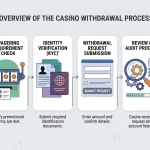
A pending Bitcoin withdrawal does not necessarily mean the transaction has been sent to the blockchain. A casino may first need to approve the request, complete account checks or wait for a batch process during business hours. These operator-side steps can hold up a payout even when the withdrawal form has been submitted correctly.
A pending withdrawal may be delayed by operator-side steps, such as account checks or batch processing, before the transaction is ever broadcast to the blockchain.
Check the account’s transaction history and any messages from the operator to see whether the request is awaiting approval or has been marked as paid. If the status is unclear, ask for a specific explanation and keep the response. A clear distinction between an internal review and a broadcast Bitcoin transaction matters: the former is controlled by the operator, while the latter can be checked on the blockchain.
Do not send more money to unlock a withdrawal. A demand for an extra deposit, fee or payment before a payout is released is not a reason to transfer funds. Keep records of the request and correspondence, and do not treat a promise of immediate release as proof that another payment will solve the problem.
Why verification can interrupt a payout
KYC, or know-your-customer checks, are identity and account verification procedures. Stage-two checks may be requested at a first withdrawal or when cumulative deposits reach AUD 2,000–5,000; the trigger depends on the operator. A request may include identity or address documents. If information is incomplete, unclear or inconsistent with account details, review can take longer.
Crypto-related checks may also concern ownership of the wallet used to deposit. A specialist review describes possible requests to sign a message from the deposit address or provide a wallet screenshot showing the outgoing transaction. These are not the same as sending Bitcoin: a message signature is a way to demonstrate control of an address, while a screenshot documents a transfer. Before sharing anything, read the request carefully and avoid disclosing wallet recovery phrases or private keys. Those credentials give control of funds and are not evidence an operator needs.
New accounts and first large withdrawals may receive additional scrutiny. A security review can have a legitimate purpose, but some operators may use reviews after significant wins as a stalling tactic. Ask what is being checked, which documents are outstanding and whether the withdrawal is still under review. Save copies of submitted documents and the operator’s replies so that you can track whether the explanation changes.
Deposits that do not appear
A missing deposit can result from an address being reused, an amount arriving below the required amount, or the operator taking time to detect the transfer. Compare the transfer record in your wallet with the deposit details shown by the operator. If you contact support, provide the transaction evidence they request and ask whether the payment has been located. Do not send another deposit simply to make the account balance appear.
When a bonus becomes a dispute
Bonus terms can affect whether a balance is withdrawable. Wagering contribution percentages describe how much play on a game counts toward a bonus requirement. Contributions may differ between table games and pokies; some terms assign table games no contribution and pokies full contribution, while certain high-return slots may be capped at half contribution. If the rules are unclear, ask the operator to identify the applicable term and show how it was applied to your account.
Best Paying Online Pokies in Australia: What to Know
A bonus may also be voided if play exceeds a maximum bet limit set in its conditions. Before accepting a bonus, read the rules on eligible games, contribution rates and bet limits. If a withdrawal is refused on that basis, request the specific rule and the account activity said to have breached it. Keep the terms as they appeared when you accepted the offer, along with messages about the decision. That record will not guarantee a resolution, but it makes the disagreement concrete rather than a dispute over shifting explanations.
Delays and disputes are especially difficult to assess when the operator controls the account review and the payment status. Australian consumer protection laws do not apply to the offshore operators discussed here. Be cautious about treating a support response or a displayed account balance as confirmation that funds have been released.
Payments

Anonymous Crypto Casinos in Australia: Payments & Privacy
Bitcoin transfers depend on network confirmations, casino processing rules and BTC exchange value, while privacy...

Aristocrat Online Pokies in Australia: What to Know
The phrase alone does not verify a game, its provider, or whether an online casino...

Aussie Crypto Casinos: How Offshore Sites Work
Offshore status, crypto payments and site claims shape what can—and cannot—be verified about these services....

Best New Australian Online Pokies: Legal Limits
The guide separates game and payment searches from the legal status of real-money online casino...

Online Casino Payment Methods for Australians
Availability, processing speed, fees and withdrawal checks can differ by operator and payment route. Payment...

Best Paying Online Pokies in Australia: What to Know
Understand what offshore licences, bonus rules and Bitcoin transactions mean before assessing returns or considering...

Amex Casino Sites in Australia: Payment Guide
Amex appearing in a cashier does not establish legality, guarantee authorisation or mean withdrawals can...
Casino Sites That Accept BPAY in Australia: What to Check
BPAY availability is only one part of the picture; Australian gambling rules and a site's...

Australian casino sites that accept credit cards
A cashier’s card options do not determine legality; the guide explains Australian restrictions and how...

Casino sites accepting EcoPayz in Australia: what to check
EcoPayz availability, payment conditions and Australian legal context are separate questions; a casino listing alone...

Osko Casino Sites in Australia: Rules and Checks
Australian rules restrict operators from offering real-money online casino services locally, while payment claims require...

Casino Sites That Accept Paysafecard in Australia
Paysafecard may be listed as an account-funding option, but that alone does not confirm Australian...

Skrill and Australian Casino Sites: What to Know
Skrill listings cannot confirm an operator’s legal status, payment protection, deposit terms or withdrawal timing....

Trustly Casino Sites in Australia: What to Check
Trustly availability depends on the service and customer context; payment claims do not establish Australian...

Under an Hour Casino Withdrawals in Australia
Withdrawal timing depends on both the operator’s review and the payment method used to transfer...

No-verification casino withdrawals in Australia
A low-information sign-up does not guarantee an unchecked cashout; identity checks may arise before a...

Apple Pay at Australian Casinos: What the Evidence Shows
Everyday wallet use does not confirm casino support; this guide separates Australian payment habits from...

Bitcoin Casinos in Australia: Payments and Rules
These services generally operate offshore; the guide covers account checks, game access, bonus terms and...

Casinos That Accept Bitcoin Cash in Australia: Checks
Bitcoin Cash is only a payment method; it does not verify game access, withdrawal terms,...

CashToCode Casinos in Australia: What Can Be Verified
A payment mention or Australian-facing page alone does not confirm local acceptance, so deposits, payouts...

Ethereum Casino Payments in Australia: What to Check
Ethereum may support casino deposits and withdrawals, but payment labels alone do not establish timing,...
Casinos That Accept Google Pay in Australia
Google Pay’s everyday acceptance in Australia does not establish availability at a specific online casino...

Litecoin Casinos in Australia: Legal Context
A Litecoin payment option does not verify a casino’s legality, game availability or player protections...

Casinos That Accept Mastercard in Australia
Widespread contactless card use does not confirm that an online casino accepts Mastercard or supports...

Casinos That Accept MiFinity in Australia: What’s Verified
Card acceptance and general cashier details cannot confirm MiFinity support, so the available evidence does...

Casinos that accept Neosurf in Australia: what to know
Neosurf availability alone does not establish that an online casino can legally serve people in...

Casinos That Accept Neteller in Australia: What to Check
A practical look at what search wording can establish, why cashier terms matter, and what...

Casinos That Accept PayID in Australia: What’s Known
Australian payment habits provide context, but they do not verify a casino’s PayID options, game...

Casinos That Accept PayPal in Australia: What to Check
PayPal availability does not make an offshore casino lawful in Australia; this guide explains the...

Casinos That Accept POLi in Australia: What to Verify
POLi availability depends on each operator, and general references to Australian casinos or pokies do...

Casinos That Accept Tether USDT in Australia
Australia’s rules for online casino services and the limits of payment evidence are separate from...

Casinos That Accept Visa in Australia: What to Check
The available comparison indicates possible wider acceptance than Amex, while leaving operator support, withdrawals and...

Dragon Link Online Pokies in Australia: What to Check
A familiar game name alone does not confirm the version, availability or terms of online...

Easy Withdrawal Casinos in Australia: How Payouts Work
A practical guide to approval checks, payment-method trade-offs, bonus conditions and account details that can...

Fast withdrawal casinos in Australia: payout guide
E-wallets, cards, bank transfers and crypto differ in availability, while casino approval, verification and limits...

Instant Bank Transfers at Australian Casinos
Bank transfer can mean a direct payment or a bank-linked service, and deposit availability does...

Instant PayID Withdrawals for Real Money in Australia
PayID timing depends on operator approval and release, while bonus conditions and extra checks can...

Instant PayID Withdrawals in Australia: How They Work
PayID can move approved funds in real time, while casino checks, first withdrawals, limits and...

PayID pokies in Australia: payments and checks
PayID moves money between bank accounts through the NPP, but it does not establish whether...

No-KYC Casinos in Australia: Crypto Payments Explained
Crypto transfers may be near-instant, but account updates and withdrawal approval are separate steps with...

Online Pokies Instant Withdrawals in Australia
A withdrawal may still wait for account review and approval before the payment provider begins...

Online pokies with PayID in Australia: terms
PayID may speed up a transfer, but operator rules still determine accepted amounts, withdrawals and...

Pay by Phone Casinos in Australia: Payment Guide
The key distinction is whether a payment comes from a phone account or from a...

Quick Withdrawal Casinos in Australia: How Cashouts Work
Cashout timing depends on operator review as well as the payment route used after a...

Real cash online pokies in Australia: how they work
The guide distinguishes game credits and promotional balances from money with external value, and explains...

Safe Online Pokies in Australia: What to Check
Understand what licensing can establish, what payment checks can verify, and where protections may fall...

Same-Day Payout Casinos in Australia: What to Know
A withdrawal may move quickly only after an operator approves it; the review and transfer...

Solana casino comparison for Australians
Understand the rules for offshore casinos, how SOL payments work, and why bonus terms and...