Sun Palace Casino Registration and KYC Verification
 Available in US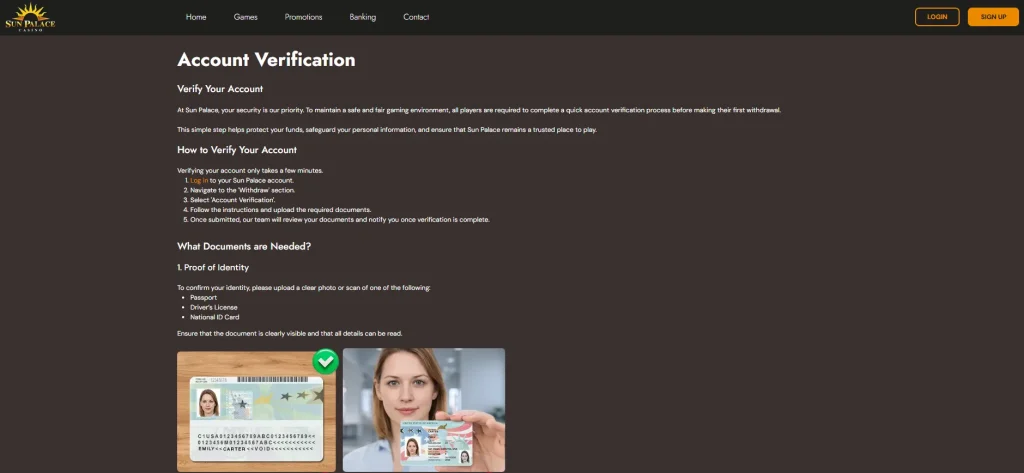
Sun Palace’s current account rules require players to meet the applicable legal age, keep only one active account in their own name and provide accurate registration information. The Terms and Conditions set the minimum at 18, or a higher age where local law requires it. Before the first withdrawal, Sun Palace requires account verification.
The official verification page gives unusually practical document guidance: identity can be shown with a passport, driver’s licence or national ID; recent address evidence can include a utility bill, bank statement or government letter; and card verification can require the first six and last four digits to remain visible while the CVV is covered. These account requirements remain separate from current registration availability for Australian residents.
Account verification interacts with deposits, bonuses, withdrawals and licensing in Sun Palace’s broader product profile (Sun Palace review).
Table of Contents
- Who can hold a Sun Palace account?
- Australian sign-up availability remains a separate question
- When verification happens
- Proof of identity
- Proof of address
- Payment-method verification and safe card masking
- Source-of-funds evidence is conditional
- How registration data connects to later withdrawals
- What Sun Palace collects for account operation
- Responsible-gaming account controls
- What to do if verification stalls
- Registration and KYC checklist
- Document quality and privacy habits
- Inactive-account rule
- Bottom line
- Recommend
Who can hold a Sun Palace account?
The Terms and Conditions state that a player must be at least 18 years old, or older if the legal gambling age in the person’s jurisdiction is higher. They also require registration information to be accurate and truthful.
Sun Palace operates a single-account policy. Each player is permitted to maintain one active account, and the terms say winnings are paid only to players who maintain a single account under their own name. Multiple active accounts can lead to winnings being voided unless the casino has given explicit authorisation.
These rules make identity consistency important from the beginning. The name used at registration, the identity document, the payment method and the address evidence should all be capable of being reconciled during verification.
Australian sign-up availability remains a separate question
Current third-party sources conflict on brand-specific Sun Palace availability in Australia, so Australian registration status requires direct confirmation at signup. The operator’s account and KYC requirements remain separate from Australian registration availability.
Australian provider law and local licensing depend on licence and safety evidence, while payment methods, language options and registration forms are product features.
When verification happens
The official account page says verification must be completed before the first withdrawal. Its process is straightforward: log in, go to Withdraw, select Account Verification, follow the instructions and upload the requested documents. The account team then reviews the submission and notifies the player when verification is complete.
Sun Palace describes the verification process while approval timing depends on document quality, additional evidence requests and account-detail matching. Processing speed can depend on document quality, additional evidence requests and whether account details match.
The practical implication is that KYC belongs in the expected first-withdrawal process from the outset. It is a defined part of the first-withdrawal lifecycle.
Proof of identity
Sun Palace’s current verification page lists three examples of acceptable identity evidence: passport, driver’s licence and national ID card. It asks for a clear photo or scan with the document details readable.
This is a category list rather than a claim that every listed document is mandatory for every account. The usual logic is that one suitable government-issued identity document is used to establish who controls the account, with additional evidence requested if necessary.
Readability matters because blurred, cropped or incomplete images can prevent the verification team from matching the document to the account information. The official instructions include examples of acceptable and problematic identity-document presentation.
Proof of address
The official account page says address evidence should be recent and issued within the last three months. It gives utility bills, bank statements and official government letters as examples. The document must show the player’s name and registered address.
the current official information states this rule. It should still be treated as a current requirement rather than a permanent promise, because verification policies can change.
A useful preparation step is to make sure the account address and the document address match in substance. Differences in spelling, abbreviations or formatting may be harmless, but a different residential address can require clarification.
Payment-method verification and safe card masking
For credit or debit card deposits, Sun Palace says it may request photographs of the front and back of the card. The current instruction is to leave the first six and last four digits visible while covering the CVV or security code on the back.
Card-verification instructions are security-sensitive. Sun Palace currently requires the first six and last four digits to remain visible while the CVV stays concealed.
Payment verification supports the same-method cashout principle explained in the withdrawals. It can help establish that the person controlling the casino account also controls the funding method.
Source-of-funds evidence is conditional
The Terms and Conditions say withdrawals may require evidence of source of funds if deemed necessary. This is broader than standard identity and address verification, but the wording is conditional.
Sun Palace reserves the right to request source-of-funds evidence during an audit or verification review, with case-specific application.
If such a request is made, the relevant support channel should be used to clarify exactly what evidence is needed rather than guessing from another casino’s process.
How registration data connects to later withdrawals
Registration quality affects later account verification. The Terms and Conditions require accurate and truthful information, and the casino can ask for government ID, proof of residence and payment ownership during withdrawal review. Inconsistent data can therefore turn a simple first cashout into a document-resolution problem.
The single-account rule adds another layer. The terms require a single account under the account holder’s control and payment methods with a verifiable ownership link to that account holder.
Each discrepancy requires case-specific review rather than automatic confiscation. It means the account should be set up and used in a way that can be documented if the operator asks for evidence.
What Sun Palace collects for account operation
The current privacy policy says account information can include full name, home address, phone number, email, login credentials, payment details, identity-verification documents and age-verification information. It also says the service processes information for account management, payments, fraud prevention and support.
This gives context for why the KYC process reaches beyond a username and password. The casino is linking identity, account ownership and financial transactions. That relationship is especially important when a withdrawal is requested.
Sun Palace account data practices are separate from the privacy practices of this informational website.
Responsible-gaming account controls
Sun Palace’s responsible-gaming page lists daily, weekly and monthly deposit limits, cooling-off periods and self-exclusion. These are account-management features rather than KYC documents, but they are relevant to the wider account lifecycle.
The same page says the service is for adults and may request identification for age verification. That reinforces the relationship between responsible-gambling controls and identity checks while avoiding any implication that the service participates in any Australian national exclusion scheme.
What to do if verification stalls
Sun Palace advertises 24/7 live chat, email support and a scheduled callback option. The contact page also says withdrawals can remain pending if account verification is incomplete or standard security checks are still underway.
A useful support request should be specific. Ask whether the verification file has been received, which category remains outstanding, whether an image needs to be resubmitted and whether the account details match the submitted document. If the issue concerns card verification, follow the masking instruction and send additional sensitive data only after a specific request.
A first withdrawal can also depend on the 1x deposit wagering rule and active bonus rules, alongside the selected payment methods.
Registration and KYC checklist
- Age: be at least 18, or older if local law sets a higher minimum.
- One account: maintain a single active account in your own name.
- Accurate details: registration information should be truthful and match later evidence.
- Identity: use a clear passport, driver’s licence or national ID when requested.
- Address: prepare recent evidence showing your name and registered address.
- Card safety: if card verification is requested, keep only the first six and last four digits visible and cover the CVV.
- First withdrawal: expect KYC to be completed before it can proceed.
- Source of funds: understand that additional evidence can be requested when considered necessary.
- Support: use live chat, email or callback for updates on document status.
Document quality and privacy habits
KYC is easier to review when the submitted image answers the requested question while keeping unrelated information private. Identity documents should be readable and complete enough to identify the holder, while card evidence should follow the casino’s masking rule rather than reveal the full card number or security code. For proof of address, the useful fields are the account holder’s name, registered address and the document date.
It is also worth keeping copies of what was submitted and the date of submission. That creates a simple record if support later asks for a replacement file or says a category remains incomplete. Send extra financial or identity documents only through a verified channel and only after a specific request. Use the operator’s stated account-verification process or confirmed support channel and ask what specific item is outstanding.
Inactive-account rule
The current Terms and Conditions contain an unusually important account-maintenance clause: an account left dormant for six continuous months is considered inactive, and the terms state that remaining balances are removed once the account is deemed inactive.
This rule is separate from registration and KYC, but it can affect an account that remains funded and unused for a long period. The current Terms and Conditions contain this rule.
Bottom line
Sun Palace publishes enough current verification detail to answer the main KYC questions directly. The account is subject to an 18+ or higher local-age rule, one active account is permitted, and verification is required before the first withdrawal. Identity, recent address evidence and payment-method ownership are the main document categories.
KYC timing depends on document quality, additional evidence requests and account-detail matching in the current Sun Palace process. Source-of-funds evidence can be requested when necessary, with the requirement applied case by case. In Australia, local account availability requires direct confirmation during registration.