PayID pokies in Australia: payments and checks
 Available in AU

PayID moves money between bank accounts through the NPP, but it does not establish whether a gambling service is legitimate or pays winnings.
Table of Contents
- PayID and online pokies: what the connection does—and does not—mean
- Paying by PayID: deposits, limits and fees
- PayID pokies in Australia in 2026: the legal context
- What PayID can offer—and where its speed has limits
- How to assess PayID claims without relying on a ‘best’ list
- Real-money transfers, withdrawals and bonus conditions
- Payments
PayID and online pokies: what the connection does—and does not—mean
PayID is a way to move money between bank accounts. It is not a certificate for an online gambling service, a measure of how its games work, or a promise that a player will receive winnings. Those are separate questions, even when a website presents PayID alongside its other payment information.
In Australia, PayID lets people make transfers using a unique identifier linked to an account, such as a mobile phone number or email address. It operates through the New Payments Platform (NPP), which supports quick transfers between banks. That describes the payment system. It says nothing by itself about the business receiving a transfer.
The distinction matters because a familiar payment name can lend a website an air of legitimacy. A PayID option may make a payment route look recognisable, but the route does not verify the recipient’s conduct or the service being offered. Seeing PayID mentioned on a page is not evidence that the operator is licensed, that its games are fair, or that it will honour a request for winnings.
The same separation applies to the games. PayID does not set game rules, determine outcomes, publish or verify return-to-player information, or oversee how a gambling service handles disputes. A payment system’s role is to facilitate a transfer; game operation and the operator’s treatment of customers are matters of the gambling service. Treating one as proof of the other confuses the channel with the party using it.
This is why phrases such as “PayID pokies” can be misleading if read as a single endorsement. The phrase may simply describe a claimed payment option associated with an online pokies service. It does not mean PayID has assessed the games or approved the operator. Nor does a transfer’s speed tell you whether a service is trustworthy. A transaction can move quickly while the recipient remains unverified.
Even a successful transfer confirms only a limited point: the payment instruction was carried out. It does not establish that the website’s claims are accurate, that an account will be treated fairly, or that any later payment will be made. The payment rail cannot answer those questions because it is not responsible for the gambling service’s promises or decisions.
Bitcoin Pokies in Australia: Payments, Risks and Rules
A useful way to read a cashier page is to separate what it says about payment from what it says about the service. Payment details describe the method a site claims to accept. Statements about licensing, game fairness, customer protection or payouts require their own evidence. One type of information cannot fill the gaps in another. A logo, a payment label or a completed transfer is not a substitute for independent scrutiny.
This distinction also applies to the word “secure”. PayID is described as a system for instant and secure transactions, but that does not make every website that mentions it secure or safe to use. Security of a payment system and the conduct of a recipient are different issues. A recognised payment method cannot guarantee that a website protects personal information, explains its terms clearly or resolves complaints properly.
For the same reason, a new PayID option does not change the nature of the service attached to it. If a gambling website adds a payment route, the change is about how money may be transferred, not about whether the games have been independently tested or whether the operator has gained authority to provide them. Payment technology can change without changing the underlying status or quality of the service.
The reverse is true too: a website’s failure to offer PayID would not, on its own, prove that its games are unfair or that it is unreliable. Payment availability is a narrow feature, not a general scorecard. It may matter to someone comparing payment methods, but it should not be used as a shortcut for judging matters it cannot establish.
For Australian readers, there is an additional reason not to treat PayID access as approval. The payment system is not the regulator of online gambling services. Its availability cannot make a prohibited service lawful, and a website’s use of an Australian payment method does not show that it is authorised to offer real-money casino games to people in Australia. Payment access and permission to provide a service are separate matters.
Legal Prohibition
Under the Interactive Gambling Act 2001, it is illegal for operators to provide real-money online casino games to people physically located in Australia.
That separation is easy to lose amid promotional language, where a payment method may be presented beside claims about fast service or reliable play. The careful reading is simpler: PayID concerns the movement of money through the NPP; the gambling operator is responsible for its own services and claims. Nothing about the first independently proves the second.
So, when you encounter PayID pokies online, read the payment reference literally and no more broadly than that. It indicates a claimed way to transfer funds. It does not establish licensing, fairness, transparency or a willingness to pay. Those are not properties transferred along with the money.
Paying by PayID: deposits, limits and fees
PayID is a transfer method, not a reason to send money to a gambling service. In Australia, real-money online casino games are prohibited for operators to provide to people in the country. The practical details below explain how PayID payments work; they are not a recommendation to use an online casino.
Where a payment page offers PayID, the process generally involves choosing it at the payment stage, following the instructions shown there, then making a transfer through your bank. The exact details can differ between payment pages. Before opening your banking app, read the instructions carefully and check the recipient information, any required reference and the minimum amount stated. Do not assume that details shown on one page will apply to another.
The account details matter. Your PayID information must match the PayID registered with your bank. If the payment page asks for account-holder information, check that it also matches the name on your bank account. A mismatch can cause a transfer to be rejected or complicate its handling. If the information does not line up, pause and contact the relevant service through its official support channel rather than trying variations or sending a test payment.
Pay by Phone Casinos in Australia: Payment Guide
PayID itself does not charge a transfer fee. Reputable venues also do not add a separate fee for PayID deposits. That does not establish that every payment route is cost-free: check the terms shown before confirming a transfer, and consult your bank’s own fee information if you are unsure. A fee described as a payment charge should be clear about who imposes it and when it applies. If the amount you are asked to send differs from what the payment page stated, do not proceed until the discrepancy is explained.
The minimum is set by the receiving service, not by PayID as a payment system. Deposit thresholds vary: many operators state a minimum in the AU$10–AU$20 range, while an affiliate review has reported some lower AU$5 minimums. These are not universal figures or a promise that a particular payment page will accept them. Check the displayed minimum before entering a transfer, and make sure the amount you intend to send is within both that threshold and your own budget.
Your bank sets your daily PayID transfer limit. An affiliate review has reported that some Australian banks, including the Big Four, sometimes block PayID transfers to gambling merchants under their acceptable-use policies. That is a reported possibility, not a statement that every bank applies a blanket block or that its policy will remain unchanged. A payment can therefore be unavailable even when PayID appears on a payment page. If your bank declines or restricts a transfer, do not try to get around the restriction by changing descriptions or splitting the payment. Check the bank’s explanation and use its official support channels.
Do
- Verify recipient details in your bank app before confirming
- Match your PayID and account-holder name with your bank records
- Contact official support if payment details do not line up
Don’t
- Rely on saved payees or earlier transactions for new transfers
- Attempt to bypass bank blocks by changing payment descriptions
- Split payments to circumvent bank transfer restrictions
Before confirming any transfer, compare the amount and recipient details shown in your bank app with the payment instructions. Read the confirmation screen rather than relying on a saved payee or an earlier transaction. Once a PayID transfer is confirmed, it cannot be reversed. If you notice an error before confirmation, stop and correct it; if a transfer has already gone to the wrong recipient, contact your bank promptly. A fast payment is not necessarily a recoverable one.
A careful check is useful because two different sets of limits may apply: your bank’s daily transfer limit and the receiving service’s deposit minimum or other stated conditions. The bank controls whether a transfer can be made within its limit; the payment page determines what it will accept. Neither should be inferred from the other. If either set of instructions is unclear, get clarification before sending money. Do not increase a bank limit or make repeated attempts simply because a payment has been declined.
PayID can make a bank-to-bank transfer quickly, but that does not settle questions about the recipient, the payment page’s terms or whether the transfer is appropriate. Treat the displayed instructions as specific to that transaction, verify each detail, and stop if anything differs from what you expected.
PayID pokies in Australia in 2026: the legal context
If you’re exploring new PayID pokies in Australia for 2026, check the available payment and operator details before choosing where to play. This reference highlights the specific information available for each listed operator.
1. LuckyVibe
License: Curacao Gaming Control Board OGL/2023/176/0095 (Hollycorn N.V.) LuckyVibe is listed under Curacao Gaming Control Board licence OGL/2023/176/0095, held by Hollycorn N.V.
2. Golden Pokies
License: Curacao Golden Pokies is listed as holding a Curacao licence.
3. Vegaz Casino
License: Curacao OGL/2024/1335/0780 · Min. deposit: EUR 20 Vegaz Casino is listed under Curacao licence OGL/2024/1335/0780. Its minimum deposit is EUR 20.
4. Bizzo Casino
License: Curacao Gaming Control Board (TechSolutions Group N.V.) Bizzo Casino is listed under the Curacao Gaming Control Board, with TechSolutions Group N.V. named.
5. DragonSlots Casino
License: Curacao Gaming Authority (Jumpman Gaming Ltd) DragonSlots Casino is listed under the Curacao Gaming Authority, with Jumpman Gaming Ltd named.
6. Kingmaker
Payout speed: crypto ~90 minutes, fiat 1-5 days · Min. deposit: A$30 Kingmaker lists crypto payouts at around 90 minutes and fiat payouts at 1–5 days. Its minimum deposit is A$30.
7. Uptown Pokies
License: Curacao (operating since 2017) · Min. deposit: A$20 Uptown Pokies is listed as operating since 2017 under a Curacao licence. Its minimum deposit is A$20.
8. GoldenCrown
License: Curacao Gaming Control Board OGL/2023/176/0095 (Hollycorn N.V.) GoldenCrown is listed under Curacao Gaming Control Board licence OGL/2023/176/0095, held by Hollycorn N.V.
9. Wild Tokyo
License: Curacao · Payout speed: crypto 30-60 minutes, fiat 1-5 days · Min. deposit: A$10 Wild Tokyo lists crypto payouts at 30–60 minutes and fiat payouts at 1–5 days. Its minimum deposit is A$10, and it is listed under a Curacao licence.
10. Ricky Casino
Payout speed: crypto under 1 hour, PayID 1-3 business days · Min. deposit: A$20 (A$30 to qualify for the bonus) Ricky Casino lists crypto payouts in under an hour and PayID payouts in 1–3 business days. The minimum deposit is A$20, or A$30 to qualify for the bonus.
PayID is a way to move money between bank accounts. Its appearance as a payment option does not change the legal status of the service receiving the transfer. In Australia, the key question is not whether a site accepts PayID, but whether it is permitted to provide the gambling service to people in Australia.
The Interactive Gambling Act 2001 makes it illegal for an operator to provide real-money online casino games to people physically located in Australia. That prohibition covers pokies as well as casino-style games such as poker, blackjack and roulette. Calling a service “new” or presenting it as a PayID casino does not create an exception. Nor does a site’s acceptance of Australian customers, its use of Australian currency or the presence of a familiar payment method establish that it is lawful.
This distinction matters because a payment system and a gambling operator have different roles. PayID operates through the New Payments Platform, which enables quick transfers between banks. It does not grant gambling permission, supervise casino games or decide whether an operator may serve Australian customers. A payment that goes through is evidence only that money moved; it is not a legal endorsement of the recipient.
What a licence can—and cannot—show
An offshore casino may claim to hold a licence from another country or jurisdiction. You can check whether that claim is genuine by looking up the operator in the public register maintained by the authority said to have issued the licence. Confirm that the register names the same legal entity and that the licence is current. A logo or licence number displayed on a casino page is not a substitute for checking the issuing authority’s own records.
Aristocrat Online Pokies in Australia: What to Know
Even a genuine foreign licence does not authorise an operator to provide real-money online casino games to people in Australia. It may describe the operator’s status under the rules of the issuing jurisdiction, but it does not override Australian law. Australia does not provide a local licence that makes offshore online casino services lawful for Australian customers. So there is no Australian online-casino licence whose presence on a site can establish that the service is permitted here.
For Australian information, consult the Australian Communications and Media Authority (ACMA), the regulator responsible for administering and enforcing relevant online gambling rules. Its public material can help you understand prohibited interactive gambling services and regulatory action. That is different from checking a foreign licence: ACMA is not an Australian licensing authority for online casinos.
The consequences sit with operators
The law targets the provision of prohibited services. The maximum daily penalty under the Interactive Gambling Act 2001 is $360,000 for an individual and $1.8 million for a body corporate. Those penalties concern people and companies that violate the Act; they should not be confused with the position of a person who uses an offshore service. The legal framework described here does not impose a fine or criminal prosecution on a player simply for playing at an offshore casino without a local licence.
That distinction is no assurance that using such a service is safe or that a dispute will be resolved in your favour. A foreign licence, where genuine, is not the same as Australian authorisation, and a payment channel cannot supply protections that the law does not provide. If a site’s terms, identity or claimed regulatory status are unclear, the uncertainty is not cured by a successful PayID transfer.
Australian authorities actively block and enforce against prohibited online casino services. As a result, access may be restricted, and a site that is reachable at one time may not remain so. A changing domain or a new payment option does not alter the underlying rule. Nor does a site’s continued availability prove that it has passed an Australian legal review.
How to read the 2026 label
The year in a site’s name, promotion or description is not a legal category. In 2026, the relevant distinction remains between a payment method and the service taking payment: PayID may facilitate a transfer, while the operator remains subject to the law governing online casino services in Australia. A fresh launch, updated cashier page or new branding cannot by itself establish permission to operate.
If you are checking a claim, separate the questions. Is the payment method available? Does a public register confirm the claimed foreign licence? And, independently, does Australian law permit the operator to offer the service to people here? An affirmative answer to either of the first two does not answer the third. In particular, PayID availability is not a signal that an operator is licensed in Australia, that its games are fair, or that it will pay winnings.
This is why a claim such as “licensed” needs context: licensed by whom, for which legal entity, and for which market? A register entry can confirm a foreign authority’s record, but it cannot convert an offshore online casino into a service authorised for Australian customers. Where a site presents payment access as proof of legality, it is combining two separate matters.
Legal Context
- PayID availability does not make a prohibited service lawful in Australia
- Foreign licences do not override the Interactive Gambling Act 2001
- A successful payment is not evidence of an operator’s licensing or fairness
- ACMA is the regulator for enforcement, not a licensing authority for online casinos
For a current view of the Australian rules, use ACMA’s public guidance on prohibited interactive gambling services and enforcement. For a foreign licence claim, use the issuing regulator’s own public register rather than relying solely on the casino’s description. These checks answer different questions; neither PayID nor a foreign licence changes the Australian prohibition on operators providing real-money online casino games to people physically located in the country.
What PayID can offer—and where its speed has limits
PayID’s practical appeal is speed. It is an Australian payment system that lets people send money using an identifier such as a mobile number or email address, rather than entering conventional bank-account details. It operates through the New Payments Platform, which enables quick transfers between banks. In the context of online gambling services, deposits made with PayID are reported to arrive within seconds.
That describes the movement of money, not the status of the service receiving it. A fast transfer does not establish that an online casino is lawful, that a game is fair, or that winnings will be paid. Those are separate questions, and the payment rail cannot answer them. Nor should the speed of a deposit be taken as a reason to use a real-money online casino service in Australia.
There is a straightforward reason to value a quick payment method: less time may pass between sending money and seeing the transfer reflected by the recipient. But “quick” applies to the payment itself. It does not mean that every stage on either side of the transfer is immediate, or that a transaction can be undone if you change your mind.
Confirmation is the point of no return
PayID payments are irreversible once confirmed. That makes checking the details before authorising a transfer essential. A payment that has gone through is not like a draft you can cancel later; speed is useful only when the recipient and amount are correct. If something appears wrong before confirmation, pause rather than treating the ability to send quickly as a reason to proceed.
This is a practical limitation, not a small-print technicality. A transfer may move quickly precisely because the payment system is designed to process it without a long wait. Once confirmed, however, the same speed leaves little room to reconsider. Do not assume that a bank or recipient can simply reverse a completed PayID payment because you requested it.
The same distinction matters when a payment is described as “instant”. That word refers to the transfer, not to a promise about what happens after money reaches a recipient. A receiving service may have its own records, checks or account procedures. The payment rail cannot guarantee how that service handles the funds or whether it will return them.
A withdrawal has more than one clock
PayID can also carry money in the other direction. The payment method may move funds quickly, but a withdrawal from an online casino is not simply the reverse of a deposit. The casino first has to approve the request and release the funds from its own system. Only after that point does the speed of the bank transfer become relevant.
A specialist review reports that casino-initiated PayID withdrawals may spend 24–72 hours in a pending period before funds leave the casino’s system. The same kind of review says that, after casino approval, a PayID transfer generally reaches the account within the same day. These are reported timings, not a service-wide guarantee. The two stages should not be confused: a fast transfer after release does not remove time spent waiting for the casino to approve or send it.
This is why a payment method’s advertised speed can give an incomplete picture. A transfer may be fast once it is actually sent, while the request that triggers it remains under review. If a service presents “instant PayID” as though it describes the whole journey from withdrawal request to receipt, the description leaves out an important step. The relevant question is not only how quickly PayID moves money, but also when the sender releases it.
The distinction is useful beyond withdrawals. A payment system handles the transfer between accounts; it does not decide whether the underlying service should accept a payment, how it records the transaction, or what happens if there is a dispute. Those responsibilities belong elsewhere. A quick payment cannot substitute for clear terms or an accountable service.
Speed is a feature, not a safeguard
For a person making an ordinary, correctly addressed transfer, rapid processing can be convenient. For a payment connected with gambling, the same convenience should be weighed against the fact that confirmation is final. Take time to verify the recipient and the transaction before authorising it, and do not treat a successful payment as evidence that the recipient is trustworthy or that a later withdrawal will be quick.
The cautious reading of claims about PayID is therefore narrow: it can move a confirmed payment quickly, and it can also be used to transfer funds back after a recipient releases them. It cannot reverse a confirmed payment, compel a casino to approve a withdrawal, or guarantee when funds will be sent. A payment rail can shorten the transfer stage; it cannot make the stages around it disappear.
How to assess PayID claims without relying on a ‘best’ list
A page that says it accepts PayID is making a narrow claim about a payment option. That claim does not establish that the gambling service is lawful in Australia, that its games are fair, or that it will pay winnings. Treat payment availability as one detail to verify, not as a shortcut to judging the service.
Start with the cashier page—the part of a gambling site that lists payment methods and their conditions. Check whether PayID is actually shown, and whether the information appears to apply to the service you are reading about. A logo or a sentence elsewhere on the page is weaker evidence than a current, specific cashier entry. If the details are unclear or the payment option is only mentioned in promotional copy, do not assume it is available.
That check is not a recommendation to open an account or use an offshore casino. Under Australia’s Interactive Gambling Act 2001, operators cannot provide real-money online casino games to people physically in Australia. A foreign licence does not change that rule. If a site claims to be licensed, look up the named regulator and verify the licence in that regulator’s own public register; do not rely only on a badge or a claim on the site. A foreign licence may describe the operator’s status elsewhere, but it does not make providing online casino games to customers in Australia lawful. Public information from the Australian Communications and Media Authority can help you check Australian enforcement and blocking information, rather than establish an Australian casino licence.
Assessment Steps
- Verify the PayID option is listed on the actual cashier page
- Check the named regulator’s public register for licence validity
- Review ACMA public guidance on prohibited services
- Confirm bank account name matches the casino profile name
- Read bonus wagering requirements and maximum bet limits
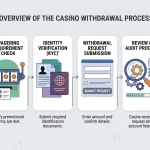
Next, look for terms that explain what happens after a payment option is selected. The page should distinguish between the payment provider’s transfer and the operator’s handling of a transaction. A specialist review reports that withdrawals may be checked internally and that processing time can depend on the operator’s review and the player’s identity-verification status. The same type of review notes that processing speeds differ between casinos. Those are reports about operator-side handling, not a promise about any particular service or a reliable forecast for your own request.
Useful terms are specific about eligibility, account verification, withdrawal requests and what can delay or prevent payment. If the wording is difficult to find, incomplete, or inconsistent across the cashier page and terms, treat that as an unresolved risk. A claim such as “fast withdrawals” is not meaningful without a clear description of the operator’s review process. Nor does a displayed payment method tell you whether a withdrawal will be approved.
Check the account rules as well as the payment rules. The bank account name should match the name on the casino profile; a mismatch can cause a withdrawal problem. The terms should explain what identity checks are required and when they may take place. Do not create multiple accounts at the same operator: its rules may treat that as a breach and lead to account restrictions or forfeiture of winnings. If a bonus is involved, read its conditions before accepting it. Exceeding the stated maximum bet while meeting wagering requirements can void the bonus and associated winnings. The detail matters more than the headline offer.
No-verification casino withdrawals in Australia
A sound assessment also depends on who is making each claim. Separate the operator’s own terms from an independent regulator’s records and from commentary by reviewers. An affiliate link should be clearly identified as advertising; a page that earns money when you sign up has a reason to encourage sign-ups. That does not automatically make every statement false, but it does mean you should verify important claims elsewhere rather than treating a favourable ranking as proof.
Be wary of pages that describe a service as “best” without explaining the basis for that judgement. A payment method can be present while other important details remain uncertain. Compare the wording of the cashier page with the actual terms, check licence claims at the named regulator, and use Australian public enforcement information for the local context. If those checks do not give a clear answer, a confident label or polished payment badge should not fill the gap.
Real-money transfers, withdrawals and bonus conditions
For anyone comparing claims about PayID and real-money play, the withdrawal figure shown in a payment screen is only part of the timeline. PayID can move funds quickly after a payment is approved, but it cannot control how long a casino takes to review a request or release it. In Australia, providing real-money online casino games to people in the country is prohibited under the Interactive Gambling Act 2001. The conditions below describe claims that may appear in casino terms and payment information; they are not an endorsement or invitation to use an online casino.
A specialist review reports that a PayID withdrawal may take 12–24 hours after the casino approves it, while an internal pending period can bring the time from request to receipt to 2–4 days. Those are reported timeframes, not a service standard. A request can remain pending before any payment is sent, and the transfer time after release is a separate stage. A fast payment method does not remove the casino’s review process.
Payments & Withdrawals for Australian Online Casinos
Another specialist review describes operator pending periods ranging from 0 to 12 hours, with manual checks taking 12–24 hours or longer over weekends. It also reports that first withdrawals, or accounts selected for further review, may take 24–48 hours at the slower end. These estimates may not apply to every operator or request. The status shown in an account, and the operator’s written terms, are more useful than a general claim of instant payment.
Minimums and deductions
A specialist review reports withdrawal minimums of A$20–A$50 at many operators. That threshold determines how much you must request before a withdrawal can be submitted; it does not mean the full amount will necessarily arrive. The same review reports that some operators deduct A$5–A$10 when a withdrawal falls below an internal threshold, which it identifies as commonly A$100 or A$200. These figures are operator-specific claims, not universal rules.
A separate specialist review reports that some casinos charge A$2–A$5 for each withdrawal. The fee may be distinct from a deduction applied to smaller requests, so check whether the terms describe one charge or both. Look for the minimum payout, any threshold-based deduction, and any per-withdrawal fee in the cashier information and withdrawal rules. If terms are unclear about what will be deducted, the amount received cannot be judged from the requested amount alone.
PayID itself does not charge a transfer fee, but that does not settle whether a casino applies its own withdrawal charge. The relevant question is what the operator says it will deduct from a payout, not whether the payment system itself charges for moving money. Conditions can differ between payment methods and operators, so a fee listed for one route should not be assumed to apply to another.
Reviews and account checks
Casino withdrawals may be subject to internal review before funds are released. A request can take longer if the casino asks for identity checks or other account information; whether those checks are complete can affect the processing time. Read the withdrawal rules alongside the account-verification requirements, and keep copies of the terms that apply when a request is made. A displayed processing estimate is not the same as a guarantee of when funds will arrive.
PayID details must match the details registered with the bank. For a withdrawal, the account name should also match the name on the casino profile; differences can lead to a failed or delayed payout. Avoid assuming that a transfer is complete just because a request has been accepted. A pending request, an approved request and money received in the bank account are different stages.
Bonus conditions
A bonus can make the amount available to play look larger, but it may also place conditions on when funds can be withdrawn. A specialist review reports wagering requirements of 30x–45x the bonus amount. Wagering requirements specify how much qualifying play must take place before bonus-related funds can be withdrawn. The precise calculation and which games count depend on the terms; the headline bonus amount alone does not explain the obligation.
Pay particular attention to the maximum bet allowed while meeting a wagering requirement. If you exceed the stated maximum bet, the stated consequence is that the bonus and associated winnings are voided. That can remove funds you expected to withdraw, even if the account balance appeared to include them. Read the bonus rules before accepting an offer, including the permitted bet size, qualifying activity and any restrictions on withdrawals.
The practical distinction is straightforward: PayID concerns the transfer, while minimums, deductions, review periods and bonus rules are set by the operator. None of those payment or promotional conditions changes the legal status of providing online casino games to people in Australia.
Are online pokies legal in Australia?
Real-money online casino games are prohibited for operators to provide to people in Australia.
Is it legal to play pokies games with PayID in Australia?
PayID does not make an online gambling service lawful. Its availability is only about transferring money; it does not authorise an operator to offer real-money casino games in Australia.
How do you get started with PayID pokies?
Where a payment page offers PayID, choose it, follow the displayed instructions and make the transfer through your bank. Check the recipient details and required reference, and ensure your PayID matches the one registered with your bank; remember that confirmed transfers are irreversible. This describes the payment process, not a recommendation to use an online casino.
What is the minimum PayID deposit?
Typical minimums are A$10–A$20, although some operators accept deposits from A$5. Check the payment page for the minimum it specifies.
How long do PayID withdrawals take?
After approval, a PayID transfer usually arrives within the same day, often within 12–24 hours. A casino’s pending period and internal review can make the total time from request to receipt around 2–4 days; timing also depends on your KYC status.
Is PayID safe at an online casino?
PayID is designed for secure transfers, but that does not establish that a casino is safe or trustworthy. It does not verify the recipient or guarantee fair games, protection of your information or payment of winnings, and confirmed transfers are irreversible.
Payments

Anonymous Crypto Casinos in Australia: Payments & Privacy
Bitcoin transfers depend on network confirmations, casino processing rules and BTC exchange value, while privacy...

Aristocrat Online Pokies in Australia: What to Know
The phrase alone does not verify a game, its provider, or whether an online casino...

Aussie Crypto Casinos: How Offshore Sites Work
Offshore status, crypto payments and site claims shape what can—and cannot—be verified about these services....

Best New Australian Online Pokies: Legal Limits
The guide separates game and payment searches from the legal status of real-money online casino...

Online Casino Payment Methods for Australians
Availability, processing speed, fees and withdrawal checks can differ by operator and payment route. Payment...

Best Paying Online Pokies in Australia: What to Know
Understand what offshore licences, bonus rules and Bitcoin transactions mean before assessing returns or considering...

Bitcoin Pokies in Australia: Payments, Risks and Rules
Bitcoin is a payment method, not a slot-game format; the distinction affects how risks, withdrawals...

Amex Casino Sites in Australia: Payment Guide
Amex appearing in a cashier does not establish legality, guarantee authorisation or mean withdrawals can...

Casino Sites That Accept BPAY in Australia: What to Check
BPAY availability is only one part of the picture; Australian gambling rules and a site's...

Australian casino sites that accept credit cards
A cashier’s card options do not determine legality; the guide explains Australian restrictions and how...

Casino sites accepting EcoPayz in Australia: what to check
EcoPayz availability, payment conditions and Australian legal context are separate questions; a casino listing alone...

Osko Casino Sites in Australia: Rules and Checks
Australian rules restrict operators from offering real-money online casino services locally, while payment claims require...

Casino Sites That Accept Paysafecard in Australia
Paysafecard may be listed as an account-funding option, but that alone does not confirm Australian...

Skrill and Australian Casino Sites: What to Know
Skrill listings cannot confirm an operator’s legal status, payment protection, deposit terms or withdrawal timing....

Trustly Casino Sites in Australia: What to Check
Trustly availability depends on the service and customer context; payment claims do not establish Australian...

Under an Hour Casino Withdrawals in Australia
Withdrawal timing depends on both the operator’s review and the payment method used to transfer...

No-verification casino withdrawals in Australia
A low-information sign-up does not guarantee an unchecked cashout; identity checks may arise before a...

Apple Pay at Australian Casinos: What the Evidence Shows
Everyday wallet use does not confirm casino support; this guide separates Australian payment habits from...

Bitcoin Casinos in Australia: Payments and Rules
These services generally operate offshore; the guide covers account checks, game access, bonus terms and...

Casinos That Accept Bitcoin Cash in Australia: Checks
Bitcoin Cash is only a payment method; it does not verify game access, withdrawal terms,...

CashToCode Casinos in Australia: What Can Be Verified
A payment mention or Australian-facing page alone does not confirm local acceptance, so deposits, payouts...

Ethereum Casino Payments in Australia: What to Check
Ethereum may support casino deposits and withdrawals, but payment labels alone do not establish timing,...

Casinos That Accept Google Pay in Australia
Google Pay’s everyday acceptance in Australia does not establish availability at a specific online casino...

Litecoin Casinos in Australia: Legal Context
A Litecoin payment option does not verify a casino’s legality, game availability or player protections...

Casinos That Accept Mastercard in Australia
Widespread contactless card use does not confirm that an online casino accepts Mastercard or supports...

Casinos That Accept MiFinity in Australia: What’s Verified
Card acceptance and general cashier details cannot confirm MiFinity support, so the available evidence does...

Casinos that accept Neosurf in Australia: what to know
Neosurf availability alone does not establish that an online casino can legally serve people in...

Casinos That Accept Neteller in Australia: What to Check
A practical look at what search wording can establish, why cashier terms matter, and what...

Casinos That Accept PayID in Australia: What’s Known
Australian payment habits provide context, but they do not verify a casino’s PayID options, game...

Casinos That Accept PayPal in Australia: What to Check
PayPal availability does not make an offshore casino lawful in Australia; this guide explains the...

Casinos That Accept POLi in Australia: What to Verify
POLi availability depends on each operator, and general references to Australian casinos or pokies do...

Casinos That Accept Tether USDT in Australia
Australia’s rules for online casino services and the limits of payment evidence are separate from...

Casinos That Accept Visa in Australia: What to Check
The available comparison indicates possible wider acceptance than Amex, while leaving operator support, withdrawals and...

Dragon Link Online Pokies in Australia: What to Check
A familiar game name alone does not confirm the version, availability or terms of online...

Easy Withdrawal Casinos in Australia: How Payouts Work
A practical guide to approval checks, payment-method trade-offs, bonus conditions and account details that can...

Fast withdrawal casinos in Australia: payout guide
E-wallets, cards, bank transfers and crypto differ in availability, while casino approval, verification and limits...

Instant Bank Transfers at Australian Casinos
Bank transfer can mean a direct payment or a bank-linked service, and deposit availability does...

Instant PayID Withdrawals for Real Money in Australia
PayID timing depends on operator approval and release, while bonus conditions and extra checks can...

Instant PayID Withdrawals in Australia: How They Work
PayID can move approved funds in real time, while casino checks, first withdrawals, limits and...

No-KYC Casinos in Australia: Crypto Payments Explained
Crypto transfers may be near-instant, but account updates and withdrawal approval are separate steps with...

Online Pokies Instant Withdrawals in Australia
A withdrawal may still wait for account review and approval before the payment provider begins...

Online pokies with PayID in Australia: terms
PayID may speed up a transfer, but operator rules still determine accepted amounts, withdrawals and...

Pay by Phone Casinos in Australia: Payment Guide
The key distinction is whether a payment comes from a phone account or from a...

Quick Withdrawal Casinos in Australia: How Cashouts Work
Cashout timing depends on operator review as well as the payment route used after a...

Real cash online pokies in Australia: how they work
The guide distinguishes game credits and promotional balances from money with external value, and explains...

Safe Online Pokies in Australia: What to Check
Understand what licensing can establish, what payment checks can verify, and where protections may fall...

Same-Day Payout Casinos in Australia: What to Know
A withdrawal may move quickly only after an operator approves it; the review and transfer...

Solana casino comparison for Australians
Understand the rules for offshore casinos, how SOL payments work, and why bonus terms and...