Online Pokies E-Wallets in Australia: Payment Guide
 Available in AU

E-wallet availability depends on the site and provider, while payment logos do not confirm eligibility or guarantee a payout.
Table of Contents
- How E-Wallet Payments Work at Offshore Pokies Sites
- Real-Money Play, Accounts and the Australian Legal Position
- What an Australian E-Wallet Casino Directory Can—and Cannot—Tell You
- Depositing and Withdrawing AUD: Methods, Delays and Bank Blocks
- Assessing a Newly Encountered E-Wallet Casino
- Playing on a Phone: Browser, PWA and App-Safety Differences
- Bonus Terms That Can Make an E-Wallet Offer Hard to Use
- Casino Apps
How E-Wallet Payments Work at Offshore Pokies Sites
An e-wallet sits between your bank or other funding source and an online account. You add funds to the wallet, then use its balance to pay a site that accepts it. If the site also permits withdrawals to that wallet, a payout can travel back through the same route. The wallet is therefore a payment channel, not a guarantee that a deposit will be accepted or a withdrawal released.
MiFinity, Skrill and Neteller are examples of e-wallets used for both deposits and withdrawals at some offshore pokies sites. Availability depends on the site and the wallet provider: seeing a payment logo on a page does not necessarily mean the method is available to every customer or for every transaction. Check the cashier’s current terms and the wallet’s own conditions before moving money.
The sites discussed in this context are offshore and crypto-friendly. That description does not make them Australian services or imply Australian approval. The Interactive Gambling Act 2001 prohibits operators from providing online casino-style games to people in Australia. If you are considering any offshore site, confirm directly that it accepts your location before depositing. Access may be blocked by the Australian Communications and Media Authority (ACMA); do not use a VPN to get around a block. A VPN may breach the site’s terms, void winnings or result in account closure.
When choosing an online pokies site with e-wallet use in mind, you should check the operator details that are available and confirm payment options directly before depositing. This list offers a concise reference to the known licensing, deposit and payout information for each site.
1. LuckyVibe
License: Curacao Gaming Control Board OGL/2023/176/0095 (Hollycorn N.V.) LuckyVibe is listed under a Curacao Gaming Control Board licence, OGL/2023/176/0095, held by Hollycorn N.V.
2. Golden Pokies
License: Curacao Golden Pokies is listed with a Curacao licence.
3. Vegaz Casino
License: Curacao OGL/2024/1335/0780 · Min. deposit: EUR 20 Vegaz Casino lists a Curacao licence, OGL/2024/1335/0780, and a minimum deposit of EUR 20.
4. Bizzo Casino
License: Curacao Gaming Control Board (TechSolutions Group N.V.) Bizzo Casino is listed under the Curacao Gaming Control Board, with TechSolutions Group N.V.
5. DragonSlots Casino
License: Curacao Gaming Authority (Jumpman Gaming Ltd) DragonSlots Casino is listed with the Curacao Gaming Authority, with Jumpman Gaming Ltd.
6. Kingmaker
Payout speed: crypto ~90 minutes, fiat 1-5 days · Min. deposit: A$30 Kingmaker lists a minimum deposit of A$30. Its stated payout times are around 90 minutes for crypto and 1–5 days for fiat.
7. Uptown Pokies
License: Curacao (operating since 2017) · Min. deposit: A$20 Uptown Pokies is listed with a Curacao licence and has operated since 2017. Its minimum deposit is A$20.
8. GoldenCrown
License: Curacao Gaming Control Board OGL/2023/176/0095 (Hollycorn N.V.) GoldenCrown is listed under a Curacao Gaming Control Board licence, OGL/2023/176/0095, held by Hollycorn N.V.
9. Wild Tokyo
License: Curacao · Payout speed: crypto 30-60 minutes, fiat 1-5 days · Min. deposit: A$10 Wild Tokyo lists a Curacao licence and a minimum deposit of A$10. Its stated payout times are 30–60 minutes for crypto and 1–5 days for fiat.
10. Ricky Casino
Payout speed: crypto under 1 hour, PayID 1-3 business days · Min. deposit: A$20 (A$30 to qualify for the bonus) Ricky Casino lists a minimum deposit of A$20, or A$30 to qualify for the bonus. Its stated payout times are under 1 hour for crypto and 1–3 business days for PayID.
Deposits and withdrawals are separate steps
A deposit is a payment into the site account. A withdrawal is a request to send an available balance out. The fact that an e-wallet appears as a deposit option does not establish that it can receive withdrawals. Some sites restrict withdrawals to particular methods, and the available choices may differ from the deposit screen. Read the payment terms and check the withdrawal options before you fund an account.
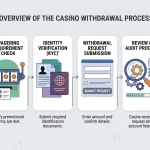
A withdrawal request may not be sent to the wallet as soon as you submit it. The casino can first hold it in a pending period, during which the request has not yet been completed. The duration and rules of that period are set by the operator, so check the terms rather than assuming that a displayed request is already on its way. The wallet’s processing time begins only after the casino releases the payment.
A specialist review describes e-wallet withdrawals as arriving within 24 hours after the casino’s pending period. That is a reported timing, not a promise that applies to every site or transaction. Another specialist review puts crypto and e-wallet withdrawal processing at under 24 hours, but this does not remove the separate wait while a casino is handling a request. A longer pending period, additional checks or a problem with the payment details can change the overall wait. The useful question is not simply “How fast is the wallet?” but “When does the casino approve and send the withdrawal, and what happens after that?”
Pocket Pokies Casino in Australia: Meaning and Safety
What a payment status tells you
A wallet transaction can have several stages: the site records the deposit, the wallet processes the transfer, and the site updates your account balance. For a withdrawal, the order runs in reverse after the casino has approved and released the request. A status such as “pending” should not be read as “paid”; it indicates that the process is still underway. Keep the site’s confirmation and any wallet transaction record so you can compare the two if the status does not update.
If a withdrawal appears delayed, first check whether the casino still shows it as pending or whether it has marked it as sent. Those are different points in the process. Then check the wallet account and the payment details used for the request. Avoid submitting repeated withdrawal requests simply because the first one has not appeared; the site’s terms determine how requests are handled, and duplicate instructions may make it harder to follow the transaction.
An e-wallet can separate the site from your main bank account in the payment flow, but it does not remove the risks of using an offshore casino. It cannot settle a dispute about whether the casino owes you money, nor does it guarantee that a payout will be honoured. There is no Australian government body to complain to if an offshore casino refuses to pay winnings. Consider that lack of recourse before deciding whether to deposit, rather than treating a familiar wallet brand as a substitute for oversight.
Do
- Use payment methods and accounts that belong to you
- Match site details with your wallet account
- Keep records of deposits and withdrawal requests
- Confirm location acceptance directly before depositing
Don’t
- Use a VPN to bypass access blocks
- Assume a visible payment logo proves lawful service
- Ignore unclear pending periods or withdrawal processes
- Send funds without confirming location acceptance
Use only payment methods and accounts that belong to you, and check that the details on the site match the wallet account. Keep records of deposits, withdrawal requests and messages about any payment delay. If the site does not clearly explain its pending period, withdrawal process or accepted locations, that uncertainty is relevant before you send funds. Confirm location acceptance directly before depositing; a payment option being visible does not prove that the operator can lawfully or reliably serve you where you are.
Real-Money Play, Accounts and the Australian Legal Position
The legal distinction is between the operator offering a service and an individual accessing it. Under the Interactive Gambling Act 2001, operators must not provide real-money online casino-style games to people located in Australia. The prohibition covers casino services such as poker and table games as well as pokies. It is directed at the service provider; playing at an offshore casino is not, by itself, an offence for an individual under this Act.
That distinction does not make offshore gambling an Australian-regulated activity, or give a punter the protections they might expect from a local service. The sites discussed in connection with e-wallet access are offshore and crypto-friendly. Their location and payment options do not change the Australian rules that apply to operators, and do not establish that a particular site is lawful to offer to people here. ACMA actively blocks access to illegal gambling sites, so a page being reachable at one time is not evidence of approval or reliable access.
Before depositing, confirm directly in the site’s terms or with its support team that it accepts customers in your Australian state or territory. Do not infer acceptance from an e-wallet appearing at checkout, a working login page, or another punter’s account. A site may restrict access by location, and its own terms may set additional conditions. If it does not clearly accept your location, do not proceed.
Golden Pokies Casino Australia: Law and Access
There is also a practical gap in recourse. If an offshore casino refuses to release winnings, there is no Australian government body to complain to that can resolve the dispute as a domestic casino regulator would. A foreign licence or an account interface that looks familiar does not remove that limitation. The legal position for an individual under the Interactive Gambling Act should therefore not be confused with a guarantee that funds can be recovered or that an overseas operator will honour a claim.
A VPN does not resolve the problem. Using one to reach a blocked casino may breach the operator’s terms or conceal where you are accessing from. The operator may close the account or void winnings if it decides that VPN use or location misrepresentation violated its rules. That risk sits alongside the possibility of blocked access; neither the VPN nor the e-wallet login creates a right to use the service.
Age and account checks
You must be at least 18 to register and gamble in Australia. An account form accepting your details does not override that requirement. Nor does access through an e-wallet make an account anonymous: a casino can require identity documents before allowing a withdrawal, even if the deposit and login process involved fewer checks.
The first cash-out is a point at which identity verification commonly becomes necessary. This process is often called KYC, meaning “know your customer”: the operator asks for documents to check who owns the account and whether the account details match. The requested material can include a selfie or identity document and proof of address. The exact instructions depend on the operator, so read them before sending anything and use only the account’s stated verification channel.
KYC
An abbreviation for "know your customer," referring to the process where an operator asks for identity documents and proof of address to verify the account owner before allowing a withdrawal.
Verification can become a practical obstacle if the information on the account does not match the documents, if a document is unclear, or if the operator asks for further evidence. A successful login is not the same as a verified account, and a deposit being accepted does not mean a later withdrawal will be approved automatically. Keep the name and address on the account accurate, and do not use another person’s identity or payment account.
Before opening an account, read the operator’s access and verification terms, including any conditions on location and identity documents. Consider what information you would be asked to provide and whether you are comfortable sending it to an offshore business. If the terms are unclear, support cannot explain them, or the site’s location rules conflict with your own, the sensible response is not to deposit while hoping the issue will sort itself out.
Account access can also disappear if a site blocks Australian traffic or changes its terms. Save relevant account records and communications if a dispute arises, but bear in mind that keeping screenshots does not create an Australian avenue for enforcement. The central point is uncomfortable but important: the Act’s treatment of the individual punter is not an endorsement of offshore operators, and it does not supply the protections or complaint route that would make an offshore account equivalent to a locally regulated one.
What an Australian E-Wallet Casino Directory Can—and Cannot—Tell You
A directory labelled for Australian e-wallet pokies may look like a straightforward way to compare payment options. It is better understood as a starting point for checking claims, not as proof that a listed casino is available, lawful for operators to offer in Australia, or safe to use. The sites such directories describe are offshore, crypto-friendly casinos; they are not Australian-licensed online casino services.
Australian online pokies: legality, bonuses and withdrawals
That distinction matters because a payment logo or an Australian-facing page says little about whether a particular punter can register from their location, how a withdrawal would be handled, or what recourse exists if a dispute arises. A directory can organise information, but it cannot make an offshore operator accountable to Australian consumers.
What a directory can show
A well-maintained listing may identify e-wallets a site says it supports and point to the operator’s stated terms. It may also name the jurisdiction under which the operator claims to hold a licence. Jurisdictions associated with offshore casinos that accept Australian players include Curaçao, Malta—through the Malta Gaming Authority—and Gibraltar.
Those names are not interchangeable, and their appearance is not a guarantee of protection in Australia. A foreign licence is not an Australian authorisation to provide online casino games to people located here. Nor does a listing itself verify that the licence is current, that the named operator is the entity behind the website, or that the operator will resolve a payment dispute fairly. Treat a licence label as a claim to investigate, not as a local endorsement.
A directory may also become outdated. Payment methods, terms and access can change, while a page can remain online after its information has stopped reflecting the operator’s current position. Before relying on any entry, check the operator’s own current information and, crucially, confirm that it accepts customers from your location before depositing. Do not assume that a site is available simply because it appears in an Australian-focused directory.
Attention A site appearing in a directory does not guarantee it will remain reachable or that the operator is currently authorized to serve your location.
What a directory cannot establish
A list cannot override Australia’s legal framework or the work of the regulator. The Australian Communications and Media Authority, or ACMA, takes steps to prevent access to illegal gambling services, including by blocking websites. A site appearing in a directory does not mean it will remain reachable, and a block is not evidence that the directory has checked the operator’s status or resolved concerns about it.
A blocked site may prompt someone to consider a virtual private network, or VPN, to make their connection appear to come from elsewhere. That is not a reliable way to establish eligibility. Using a VPN to access a blocked casino may breach the operator’s terms and can result in winnings being voided or the account being closed. A directory cannot guarantee that disguising your location will be accepted by a casino or protect an account from those consequences.
Nor can a listing provide the kind of local complaint route a customer might expect from an Australian service. If an offshore casino refuses to pay winnings, there is no Australian government body to which you can take that complaint and expect it to resolve the payout dispute. The existence of a foreign licence does not remove this practical limitation. That is one of the most important things a directory cannot communicate through a payment-method column.
Read the entry as a lead, not a verdict
The useful question is not simply whether an e-wallet name appears beside a casino. Check whether the site’s own current terms match the directory’s description, whether Australian residents are explicitly accepted, and which legal entity and licensing jurisdiction the operator identifies. If the location question is unclear, do not deposit to find out. Acceptance can differ between sites and can change.
House of Pokies Casino in Australia: Legal and Bonus Guide
Keep the legal distinction clear, too: Australian law prohibits operators from providing real-money online casino-style games to people in Australia. That does not mean a directory turns an offshore service into a locally authorised one. ACMA’s blocking activity also means that access can be interrupted, regardless of what a listing says.
A directory can help you spot details worth checking. It cannot certify the operator, guarantee access, ensure a withdrawal, or supply Australian government protection if a dispute arises. Those limits matter more than the neatness of any list.
Depositing and Withdrawing AUD: Methods, Delays and Bank Blocks
Payment options can look straightforward until you try to move Australian dollars in or out. The methods shown on an offshore crypto-friendly casino’s cashier page may include PayID, BPAY, cards or cryptocurrency, but availability and processing times vary between sites. A payment logo is not a guarantee that the route will work for your bank, account or location. Before depositing, confirm directly with the operator that it accepts customers where you are physically located.
A specialist review describes PayID deposits as near-instant and typically free. Treat that as a reported feature, not a dependable promise: the operator’s current cashier information and your bank’s own handling of the transfer matter. Check the payment instructions before sending money, including the recipient details, any stated fees and whether the amount will be credited in AUD. If the casino displays a different currency, check what the payment screen says before authorising a transfer; an exchange rate or conversion charge can affect the amount received.
Some Australian banks may flag or block charges identified as gambling-related, which can result in declined transactions regardless of the card’s validity.
BPAY is another method that specialist reviews list among the options offered by some mobile casinos. Its presence does not establish a standard processing time across operators. Follow the casino’s instructions carefully and retain the confirmation from your bank or payment service. If the balance is not updated, that record can help you explain what happened when contacting the operator. Do not send a second payment simply because the first one has not appeared immediately: first check the transaction status and ask support to trace it.
POLi is not a current route for Australian local transactions. Its Australian service ended in September 2023, so a cashier page that still presents POLi as available warrants a closer look. The label may be outdated or may not describe a functioning local payment option. Verify the method with the operator before trying to use it, and do not assume that an old help page or payment logo reflects what the service can process now.
Card payments can fail even when the card itself works elsewhere. Some Australian banks flag or block charges they identify as gambling-related, according to specialist reviews. A declined transaction may therefore reflect the bank’s policy rather than a fault with the card details or the casino account. Repeated attempts may not solve the problem. Check your bank’s explanation and the casino’s payment instructions instead; do not use a different person’s card or provide inaccurate payment details to get around a decline.
Cryptocurrency is also listed among the deposit methods at some sites, but it is not a direct substitute for an AUD bank transfer. The currency, wallet instructions and confirmation process need to match the operator’s directions. Check those details before authorising a transaction, since sending funds to the wrong address or using an unsupported currency can create a separate problem from a delayed deposit. The same principle applies across methods: confirm what the cashier accepts now, rather than relying on a general list of payment options.
Depositing and withdrawing are not necessarily mirror processes. The casino’s payment page should explain which routes are available for each direction and whether a method has different conditions for withdrawals. For bank transfers, specialist reviews report that a withdrawal can take as long as five business days; that is a reported possibility, not a timetable you can assume every operator will meet. Look for the casino’s own processing information and distinguish its handling time from the time a bank may take to complete a transfer.
Keep a record of the transaction, the payment method and any confirmation shown by the bank or payment service. If a deposit is missing, give the operator enough information to investigate without sending sensitive account details through an unverified channel. If a withdrawal is delayed, ask for its status and for an explanation of any pending or processing stage. A vague promise that a payment is “on the way” does not tell you whether the casino has released it or whether another institution is still handling it.
These payment routes are offered by offshore operators, and the sites discussed are offshore and crypto-friendly. That does not make them Australian services or ensure that a particular one will accept Australian customers. Confirm your location is accepted before depositing, and do not use a VPN to get around a block: doing so may void winnings or result in the account being closed. If an offshore casino refuses to pay, there is no Australian government body that can resolve the dispute on your behalf.
Legal Risk
Using a VPN to access blocked casinos may breach operator terms, leading to voided winnings or account closure, and provides no recourse through Australian government bodies.
Assessing a Newly Encountered E-Wallet Casino
A newly launched or newly discovered e-wallet casino is not automatically safer, more suitable or easier to deal with than an established one. A fresh design and a prominent list of payment logos tell you little about what happens when you request a withdrawal. Before creating an account or depositing, check the site’s terms and payment rules, and confirm directly that it accepts customers in your Australian location.
The sites discussed in this context are offshore and crypto-friendly. That description is not an endorsement, and it does not mean an operator is authorised to provide online casino games in Australia. Offshore access can also be blocked. Do not try to get around a block with a VPN: using one may breach the site’s terms, put winnings at risk or result in your account being closed. If an offshore casino refuses to pay, there is no Australian government body that can resolve the dispute for you.
Read the withdrawal rules before depositing
Look for the withdrawal policy before choosing a payment method. Some casinos require you to withdraw through the same channel used to deposit; others offer deposit-only methods that cannot be used to receive a payout. These rules can leave you needing a different method from the one you expected, so check both the deposit and withdrawal sections rather than relying on a payment logo or a general statement that e-wallets are accepted.
A specialist review reports that some casinos apply weekly or monthly withdrawal ceilings, and gives a figure of $4,000–$10,000 per week for the limits it describes. Treat that as a reported range, not a standard that applies across operators. The terms for the site you are considering should state its own cap, how the limit is calculated and whether it differs by account status or payment route. If the wording is unclear, ask the operator for a written explanation before sending money.
A cap matters because it can affect how quickly a large balance can be paid out, even if a withdrawal request itself is approved. Check whether the published limit applies to all withdrawals combined or to each request, and whether any separate terms could reduce what is payable. Do not assume a limit shown in a promotional page is the full policy; the account terms and cashier rules may contain further conditions.
Check whether payment rules work for you
An e-wallet being available for deposits does not establish that it is available for withdrawals. A specialist review reports that some operators restrict certain methods to deposits or require the original deposit route for payouts. Confirm the rule for the exact e-wallet you intend to use, including whether the account name must match the casino account holder’s details. If you cannot find a clear answer, do not treat the uncertainty as a minor technicality: it may determine whether you can withdraw through your preferred route.
The same care applies when the site describes a method as supported. Payment options can differ between accounts and may change, so the cashier displayed to you is more relevant than a generic page. Read any conditions attached to a method before funding the account, and keep a copy of the terms that applied when you made your decision.
Verify Wallet Terms
- Check if the e-wallet is available for both deposits and withdrawals
- Confirm the account name matches the casino account details
- Review the site’s withdrawal policy and any associated caps
- Verify that the operator explicitly accepts your Australian location
Look for controls you can actually use
Spending controls are worth checking before play, not after you have already deposited. A specialist review describes controls that can limit deposits, losses or wagering, set a maximum session length, or let a punter exclude themselves from the account. Those tools are not interchangeable. A deposit cap restricts money paid in; a loss limit concerns losses; and a session timer can prompt you to stop without limiting either of those amounts.
Find out where the controls sit in the account settings and what happens after you activate them. Check whether you can set limits yourself, whether you can lower them promptly, and whether an increase or removal takes effect immediately. The site’s terms should explain the process. If the controls are hard to locate or their effect is vague, do not assume that contacting support will create a reliable barrier.
Consider your own budget separately from any limit the operator makes available. A site setting is not a substitute for deciding in advance what you can afford to lose, and an optional tool only helps if it is clear and usable. If you need a firm break, look for self-exclusion rather than relying only on reminders or session timers.
Before proceeding, make sure the operator explicitly confirms that Australian residents can register from your location. Do not infer acceptance from the language, currency or payment methods shown on the site. Read the withdrawal cap, method rules and control settings before depositing, and keep records of the relevant terms. If the site’s answers are evasive or inconsistent, walking away is safer than discovering the practical limits after money is already in the account.
Playing on a Phone: Browser, PWA and App-Safety Differences
For Australian punters, a mobile browser is generally the straightforward way to access an offshore crypto-friendly casino website. The same account can be used on a phone and a desktop, so switching devices does not normally mean creating a separate profile. Before depositing, confirm directly with the operator that it accepts customers at your location; access from a phone does not change that requirement.
Real-Money Pokies on Android in Australia
A browser also avoids installing a separate casino program. You open the website in your phone’s browser and sign in there. Casino apps are uncommon in the Australian versions of Google Play and the Apple App Store, which helps explain why browser access is the default rather than an app-store download. An app appearing in a search result is not, by itself, evidence that it is official or safe.
What a PWA does
Some operators offer a Progressive Web App, or PWA. This is still the casino website, but it can be saved to your phone and opened in a way that resembles a native app. It is not the same thing as downloading a conventional app from an app store.
If the website offers the option, tap its install or add-to-home-screen prompt and confirm. The shortcut then gives you a direct way back to the site. A PWA does not create a different account or make the operator more trustworthy; it changes how you reach the website, not who runs it or how it handles your account.
If no installation prompt appears, you can continue using the mobile browser. Avoid instructions that ask you to change phone security settings or install an unfamiliar file just to make a website behave like an app.
How a PWA works
A Progressive Web App (PWA) is the casino website saved to your phone via an “install” or “add-to-home-screen” prompt. It functions as a shortcut that resembles a native app but does not change the operator’s reliability or account handling.
App-store games are not the same thing
Social and free-play casino apps use virtual credits rather than real-money gambling. They are legal to use in Australia and can be found through the major phone app stores. Their presence there does not mean that a real-money casino app is available through the same stores, or that the two types of app offer the same thing.
Real-money casino apps are rarely listed in Australian app stores. Some offshore operators may instead direct customers to install an app file from outside an official store. That is sideloading, and it carries security risks: the app’s safety depends on the operator, while the phone’s usual app-store checks may not apply. Consider whether a browser or PWA is sufficient before accepting that risk.
The offshore crypto-friendly casinos discussed here are not recommendations. Using a VPN to reach a blocked casino may breach its terms, void winnings or result in account closure. If an offshore casino refuses to pay, there is no Australian government body that can resolve the complaint for you.
When the phone struggles
Mobile problems are not necessarily caused by the casino website. A specialist review identifies a weak connection, limited available memory, an outdated browser and too many apps running in the background as possible causes of poor performance. Pages may load slowly, games may freeze, or the browser may close unexpectedly.
Try a stable connection, close unused apps and check whether your browser needs an update. If the problem continues, compare the site in another supported browser before installing anything. Do not assume that an app will fix a connection or memory problem; it may introduce additional security risks without improving the underlying issue.
Bonus Terms That Can Make an E-Wallet Offer Hard to Use
A bonus described as “no deposit” may still come with conditions that affect whether you can withdraw anything linked to it. An e-wallet does not remove those conditions: payment method and bonus rules are separate. Before accepting an offer, read its full terms rather than relying on the headline.
Wagering requirements state how much qualifying play must be completed before bonus-related funds or winnings can be withdrawn. A specialist review places welcome-bonus requirements in the range of 30x to 50x the bonus amount and describes requirements above 40x as steep. These are not universal terms: check the specific offer and how it defines the amount to be wagered. A requirement based on the bonus alone is different from one calculated on the bonus plus a deposit.
Minimum deposits can also change the real cost of an offer. A bonus may require a deposit even if the promotion is presented alongside no-deposit offers, or may only be available once a stated deposit threshold is met. Compare that condition with what you intended to spend; do not deposit simply to qualify for a promotion.
Game restrictions matter because not every game may contribute equally to wagering, and some may not count at all. Check which games qualify and whether the terms impose a cashout cap on winnings connected to the bonus. If a cap applies, completing wagering does not necessarily mean the full balance can be withdrawn.
Deadlines are another practical constraint. Specialist coverage describes some bonuses as requiring completion within 7–10 days; missing the stated expiry can mean losing the bonus. Check when the clock starts and what happens to any associated winnings when the offer expires. If the timetable does not fit your circumstances, declining the offer avoids having to chase it.
These terms may appear on offshore crypto-friendly casinos. Confirm that a site accepts people in your location before depositing. No Australian government body can resolve a complaint if an offshore casino refuses to pay winnings. A bonus is not a reason to overlook that risk, or to treat an unclear condition as harmless.
Before claiming, check the wagering requirement, eligible games, expiry date, minimum deposit and cashout cap. If any term is unclear, ask the operator to explain it in writing before accepting.
Can I play mobile casinos for real money without an app?
Yes. Most mobile casino play is through a browser, and some sites offer a Progressive Web App you can add to your home screen.
Can players use real-money mobile casinos in Australia?
Yes, playing at an offshore casino is not itself an offence for an individual under the Interactive Gambling Act 2001. However, that Act prohibits operators from offering online casino-style games to people in Australia, and offshore sites are not Australian-regulated.
Can I use a VPN to access blocked casino sites in Australia?
No. Do not use a VPN to get around an ACMA block; it may breach the site’s terms, void winnings or lead to account closure.
Should players use a browser or an app?
A browser is the usual option: casino apps are rarely listed on Australian app stores. Some sites offer a Progressive Web App, which works like a shortcut to the casino website.
Can I use the same account on my phone and computer?
Yes. Most Australian mobile casinos use the same account on mobile and desktop.
Can I play for free at Australian mobile casinos?
Yes. Social casino apps with virtual credits are available through the Google Play Store and Apple App Store in Australia.
Can I use PayID at Australian casino apps?
PayID is available as a deposit method at some mobile casinos and is near-instant and typically free. Most casinos are accessed through a browser rather than a native app, so check the site’s cashier for available methods.
Is it safe to play at mobile casinos in Australia?
There is no guarantee of safety when using an offshore casino: an e-wallet does not ensure a payout, and there is no Australian government body to complain to if the casino refuses to pay. Consider the lack of Australian oversight before depositing.
Casino Apps

Australian mobile casinos: access, payments and play
Compare browser, shortcut and app access, then review funding, withdrawals, game performance and account limits...

Casino apps for Android in Australia: how access works
Compare browser access, downloadable apps and virtual-credit play, along with bonus conditions, the legal position...

iPhone Casino Access in Australia: Apps and Risks
Most play happens through a mobile website or PWA, with important distinctions around real-money access,...

Casino apps in Australia: access, rules and risks
Australian casino apps may offer virtual credits or real-money gambling, but the legal position and...

Instant Withdrawal Casinos in Australia: How Payouts Work
Withdrawal timing can depend on verification, bonus conditions and payment-method rules, not just how quickly...

International Casinos for Australian Players: A Guide
The guide separates offshore location and licensing claims from Australian rules, and outlines checks around...

Offshore Casinos for Australian Players: Access
Access from Australian phones commonly uses a browser or PWA, while licences and promotional terms...

RTG Casinos in Australia: Games, Risks and Terms
The guide explains RTG game formats, what testing can establish, and the limits of verifying...

Australian casino sites and slots: how play works
A practical guide to RNG results, game rules, bonus conditions, legal checks and payment details...

Golden Pokies Casino Australia: Law and Access
The guide separates operator restrictions from player liability and outlines offers, game terms, verification and...

House of Pokies Casino in Australia: Legal and Bonus Guide
The guide explains Australia’s rules for offshore casino services and outlines bonus conditions, verification, account...

Inclave Casinos in Australia: Rules and Access
Australia’s rules focus on the gambling service supplied, while listings and promotions alone do not...

iPad Casinos in Australia: Device Compatibility
A loaded casino page does not guarantee that its games work on an iPad; device...

Pocket Pokies Casino in Australia: Meaning and Safety
The guide distinguishes a named casino service from mobile pokies and explains what the wording...

Online pokies Australia: real-money no-deposit offers
Understand the difference between real-money offers and virtual credits, and how terms, mobile access and...

Real-Money Pokies on Android in Australia
A practical overview of app and browser options, free-play limits, offshore operator status and common...

Real-Money Pokies Apps in Australia: Mobile Guide
Mobile casino access may mean a browser site, a shortcut or an installed app, with...

Australian online pokies: legality, bonuses and withdrawals
A practical guide to checking offers, account access, payments and the legal limits on offshore...