RTG Casinos in Australia: Games, Risks and Terms
 Available in AU

The guide explains RTG game formats, what testing can establish, and the limits of verifying offshore casinos, bonuses and cash-outs.
Table of Contents
- What RTG Games Include
- How RTG’s Software Is Tested
- RTG Casinos and the Limits of the Available Directory
- Offshore RTG Casinos: Australian Legal and Consumer Risks
- Progressive Jackpots, Volatility and Slot Returns
- Playing RTG Games for Free and Understanding Bonus Winnings
- Real-Money Play: Bonus Terms Before You Deposit
- Licensing and Oversight Behind RTG Casinos
- What Can—and Cannot—Be Verified About New RTG Slots
- Payments and Cash-Out Timing for Australian-Facing Casinos
- Casino Apps
What RTG Games Include
RealTime Gaming’s catalogue covers several types of casino-style games rather than a single format. It includes online pokies, video poker, table games whose results are generated by a random number generator, and specialty options such as scratch cards, keno, craps and bingo. The formats differ in how you interact with them: some centre on spinning reels, while others use cards, numbered selections, dice or bingo-style draws.
Online pokies are the most recognisable reel-based category. A game presents symbols on reels, and the player’s task is to start a spin and see which symbols appear. That broad description does not mean every title has the same layout or rules; the details are specific to each game. RTG’s portfolio includes this category, often referred to in Australia as pokies, but the label alone tells you little about the particular rules or presentation of an individual title.
Video poker combines a digital card display with poker-style hand rankings. Rather than dealing with a live opponent, you make decisions within the game’s own format, with the result determined by the software. It is distinct from a table game simply presented on a screen: the play revolves around forming a card hand, not taking turns around a virtual table.
Choosing an RTG casino in Australia is easier when you can see the specific details available for each option. Use these notes to focus on the licensing, deposit, or payout information that matters most to you.
1. LuckyVibe
License: Curacao Gaming Control Board OGL/2023/176/0095 (Hollycorn N.V.) LuckyVibe lists a Curacao Gaming Control Board licence, OGL/2023/176/0095, held by Hollycorn N.V.
2. Golden Pokies
License: Curacao Golden Pokies is listed as operating under a Curacao licence.
3. Vegaz Casino
License: Curacao OGL/2024/1335/0780 · Min. deposit: EUR 20 Vegaz Casino lists Curacao licence OGL/2024/1335/0780 and a minimum deposit of EUR 20.
4. Bizzo Casino
License: Curacao Gaming Control Board (TechSolutions Group N.V.) Bizzo Casino lists a Curacao Gaming Control Board licence held by TechSolutions Group N.V.
5. DragonSlots Casino
License: Curacao Gaming Authority (Jumpman Gaming Ltd) DragonSlots Casino lists a Curacao Gaming Authority licence held by Jumpman Gaming Ltd.
6. Kingmaker
Payout speed: crypto ~90 minutes, fiat 1-5 days · Min. deposit: A$30 Kingmaker lists a minimum deposit of A$30. Its stated payout speed is around 90 minutes for crypto and 1–5 days for fiat.
7. Uptown Pokies
License: Curacao (operating since 2017) · Min. deposit: A$20 Uptown Pokies is listed as operating under a Curacao licence since 2017, with a minimum deposit of A$20.
8. GoldenCrown
License: Curacao Gaming Control Board OGL/2023/176/0095 (Hollycorn N.V.) GoldenCrown lists a Curacao Gaming Control Board licence, OGL/2023/176/0095, held by Hollycorn N.V.
9. Wild Tokyo
License: Curacao · Payout speed: crypto 30-60 minutes, fiat 1-5 days · Min. deposit: A$10 Wild Tokyo lists a Curacao licence and a minimum deposit of A$10. Its stated payout speed is 30–60 minutes for crypto and 1–5 days for fiat.
10. Ricky Casino
Payout speed: crypto under 1 hour, PayID 1-3 business days · Min. deposit: A$20 (A$30 to qualify for the bonus) Ricky Casino lists a minimum deposit of A$20, or A$30 to qualify for the bonus. Its stated payout speed is under an hour for crypto and 1–3 business days for PayID.
RTG also offers RNG table games. RNG means random number generator: in this context, the software produces the result rather than a physical dealer or a live table determining it. This category includes familiar casino table formats, though the exact selection and rules can differ between games. The term describes how results are generated; it does not itself explain every rule, interface or available option.
The specialty category brings together games that do not fit neatly into reels, poker or conventional table formats. Scratch cards are presented around revealing concealed results. Keno involves selecting numbers and comparing them with a draw. Craps is based on dice, while bingo centres on matching drawn numbers against a card. These are broad descriptions of the formats, not a substitute for reading the rules displayed for a specific game.
Taken together, the categories give RTG’s software a wider range than pokies alone. If you are trying to understand what an RTG online casino might offer, the useful starting point is the game type: reel-based play, card-based play, RNG table formats or a specialty game. The provider’s name identifies the software category, but it does not make every game interchangeable. Familiarity with one format should not be taken to mean that another follows the same rules.
RTG games can be played in demo mode or real-money mode. Demo play lets you use a game without staking real money; real-money play involves wagers with monetary value. The difference is important even when the screen and controls look similar. A demonstration may show how the interface works, but it is not the same as wagering real funds, and activity in one mode should not be assumed to carry over to the other.
Casino apps in Australia: access, rules and risks
Demo mode can be useful for learning where a game displays its instructions and how its controls are arranged. You can inspect the basic flow without treating the result as a financial outcome. The precise options available depend on the game and the way it is presented. A demo is not a promise about future results, nor does it establish what would happen under real-money conditions.
The real-money mode is a separate way to play, not merely a label for the same no-cost experience. It involves a monetary stake, so the distinction should be clear before any game begins. This description is about the modes supported by RTG games; it is not a recommendation to access or use an online casino. In Australia, real-money online casino services are prohibited for operators under the Interactive Gambling Act 2001, so the availability of a software mode should not be confused with permission for an operator to provide that service locally.
The same distinction applies across the catalogue. A demo version may be available for a poker game, a table format or a specialty title, just as it may be for a pokie; the available mode is a feature of the game’s presentation. It does not change the underlying category. Reading the displayed rules remains necessary, especially where the format is unfamiliar, because names such as keno, craps and video poker refer to different kinds of play.
Online Pokies
Reel-based games where players spin symbols to achieve specific layouts or rules.
Video Poker
Digital card games combining poker-style hand rankings with software-determined results.
RNG Table Games
Casino table formats where outcomes are produced by a random number generator rather than a live dealer.
Specialty Games
Diverse options including scratch cards, keno, craps, and bingo that do not fit conventional formats.
For a quick overview, RTG’s portfolio includes online pokies, video poker, RNG table games, scratch cards, keno, craps and bingo. Its games support demo and real-money modes, but those modes are not equivalent: one is for play without a real-money stake, while the other involves wagering money. Knowing the category and mode gives you a clearer account of what the software contains without treating the provider’s catalogue as a single kind of game.
How RTG’s Software Is Tested
RealTime Gaming, generally known as RTG, develops casino software. The company was founded in Atlanta in 1998 and later moved its operations to Costa Rica. That history identifies the provider behind the software; it does not, by itself, tell you how a particular casino is run or whether an individual game will produce a win.
RTG’s games use a certified Random Number Generator, or RNG. An RNG is a system that produces number sequences used to determine game outcomes. In a game based on chance, the sequence helps decide what happens when you play. The next result is not something a player can infer simply from previous results: a run of losses does not establish that a win is due, and a recent win does not mean another is more or less likely.
RTG’s RNG is audited by independent testing agencies, including Technical Systems Testing (TST). An independent audit is an assessment by an organisation outside the software provider, rather than a statement made solely by the company whose system is being examined. Certification and testing are relevant because they provide a check on the random-number system used to produce outcomes.
iPhone Casino Access in Australia: Apps and Risks
That check has a specific scope. It concerns the RNG and its role in generating outcomes; it is not a promise that you will win, that a particular session will be fair to your personal expectations, or that a casino will handle every account or payment properly. A random process can produce streaks and uneven results. Testing does not remove that uncertainty, and it cannot turn chance into a predictable pattern.
It is also useful to separate the software provider from the casino offering access to its games. RTG develops the software, while a casino operates the site where you may encounter it. An audit of an RNG should not be read as an audit of every part of that operator’s service. It does not establish how clearly the casino presents its terms, how it handles a dispute, or whether its withdrawal rules suit you. Those are separate matters.
When you see an RTG label attached to a game, it identifies the software provider, not a forecast of the result. The same applies whether you are looking at a slot machine in demo mode or playing with money: the mode does not make a random outcome predictable. Demo play can show how a game works, but it cannot demonstrate that a real-money session will follow the same sequence or produce a particular return.
An audit of an RNG concerns the system generating outcomes; it does not guarantee personal wins or the overall operational conduct of the casino operator.
For a reader assessing RTG casino software, the useful takeaway is therefore limited but important. There is a named provider, a stated RNG system, and an independent testing role associated with it. Those details describe how the outcome-generation system is checked; they are not a substitute for examining the casino itself, and they are no reason to treat a game as a source of reliable income.
RTG Casinos and the Limits of the Available Directory
An RTG label identifies the software a casino uses; it does not tell you who operates the casino or how that business treats customers. Casinos using RTG software are separate operators, and their quality and trustworthiness can vary. A shared software provider is not a shared standard for every part of the service.
That distinction matters when you encounter a list of RTG casinos. The entries identify businesses associated with the provider, not a single network run by RTG. The name on a game does not establish who controls a player account, sets the casino’s terms or handles a complaint. Those details belong to the individual operator.
Nor does the presence of familiar RTG branding settle whether an operator is dependable. It may tell you what software appears on the site, but it cannot, by itself, verify the operator’s conduct or the protections available to a customer. Treating the software label as a seal of approval would give it a job it was not designed to do.
A list also has a practical limit: it can help you identify operators associated with RTG, but it cannot make them interchangeable. If one entry appears beside another, that proximity is not evidence that both businesses have the same standards. Each operator has to be considered on its own terms. In particular, a list should not be read as a ranking unless it clearly explains the basis for that ranking; an unranked entry is not an endorsement.
Casino apps for Android in Australia: how access works
The same caution applies to searches for an RTG slots list. A catalogue of games or a label on a casino site may help identify software, but it does not answer questions about the business behind the site. A game provider and a casino operator are different entities. Information about one should not be treated as proof about the other.
When reviewing an individual entry, separate what is directly stated from what is implied. The software association is one piece of information. Claims about an operator’s reliability are a different matter and should not be inferred from that association alone. The distinction is especially important when descriptions use broad phrases such as “RTG casino” as if they referred to a single company or uniform service.
A list is therefore best treated as a starting point for identifying separate operators, not a shortcut to a trust judgment. Its scope may also be narrower than the phrase “full list” suggests: the label alone does not establish that every RTG-using business has been included. Coverage and trustworthiness are separate questions, and neither is answered simply by seeing RTG attached to a casino name.
Keep those limits in view when comparing entries. The software connection can explain why a casino is included in an RTG directory, but it does not remove the need to assess the operator as a distinct business. A provider name is useful for identification; it is not a substitute for evidence about the operator.
Do
- Treat a list as a starting point for identification
- Assess each casino operator as a distinct business
- Separate software provider info from operator reliability
Don’t
- Use a software label as a seal of operator approval
- Assume proximity in a list implies equal standards
- Infer operator trust from an RTG association
Offshore RTG Casinos: Australian Legal and Consumer Risks
The legal distinction that matters is between the operator and the player. Under the Interactive Gambling Act 2001 and its amendments, it is illegal for an online casino operator to offer real-money casino games to people in Australia. The restriction applies to the service being provided, not to the software label on the games. An operator using RealTime Gaming software is still subject to the same rule.
Australian players are not explicitly criminalised simply for accessing an offshore casino site. That does not make the service lawful for the operator to provide, nor does it mean that playing comes with the protections you would expect from a locally authorised service. In particular, if a dispute arises, you have minimal or no protection under Australian consumer law for an offshore casino transaction.
That gap matters when an operator refuses a withdrawal, closes an account or interprets its terms in a way you dispute. There is no local Australian legal protection for resolving such casino disputes. The recourse typically available is to lodge a complaint with the regulator in the jurisdiction where the operator is based. That route depends on the foreign regulator’s processes and ability to act; it is not the same as having an Australian body resolve the dispute for you.
Access can be blocked
The Australian Communications and Media Authority (ACMA) enforces restrictions on illegal gambling services. It actively blocks access to illegal gambling sites and maintains a blacklist that continues to grow. A site appearing in search results, or having been reachable before, does not establish that it is lawful to offer services in Australia or that it will remain accessible.
Australian mobile casinos: access, payments and play
Blocking is also not a consumer guarantee. It does not settle a payment dispute, recover funds or provide an alternative local complaint process. If access to a site is disrupted, that may leave you with fewer practical ways to contact the operator, but the underlying issue remains: the service is offshore and Australian consumer protections are limited.
The phrase “RTG casino Australia” can suggest a local product or local legal status. It should not be read that way. RTG identifies the software provider; it does not make the casino an Australian operator or alter the restrictions on providing online casino games to people in Australia. A familiar brand or a working website likewise does not establish that the operator is legally entitled to serve Australian customers.
Before engaging with an offshore casino, consider the practical consequence of having to take a complaint to a foreign regulator, with little or no Australian consumer-law protection. ACMA’s blocking activity is a further reminder that these services are not part of a locally protected online casino market. No software name can remove those risks.
Progressive Jackpots, Volatility and Slot Returns
A progressive jackpot is a prize that grows as qualifying bets contribute to it. In an ordinary fixed jackpot, the advertised prize does not rise in the same way with ongoing play. With a progressive, some portion of each bet is set aside for the accumulating pool, so the prize can increase until it is won. Many RTG pokies include this kind of jackpot feature.
RTG progressive titles typically have a lower RTP than non-progressive versions because part of the stake funds the accumulating jackpot.
That funding arrangement matters when comparing returns. RTP, or return to player, is the theoretical share of stakes a game pays back over a long period of play. It is not a promise about what any one player will receive. A specialist review reports that RTG progressive titles tend to have a lower RTP than comparable non-progressive versions, since part of the stake goes toward building the jackpot rather than being returned through ordinary game wins. The jackpot is the trade-off: a larger possible prize is supported by a portion of play that is not distributed as routine payouts.
RTP and volatility describe different things. RTP concerns the proportion of stakes a game is designed to return over time; volatility describes the pattern of those returns. A high-volatility game tends to produce larger wins less often. That does not mean it will pay out a large sum during a particular session, or that a player is more likely to win overall. It means that payouts, when they occur, are generally less frequent and may be larger.
The distinction is useful when weighing up RTG slot games. A progressive jackpot can make the top prize more prominent, while high volatility can make ordinary wins less frequent. Neither feature, on its own, establishes how favourable a game is for a particular player. A title may combine a growing jackpot with a volatile payout pattern, but the jackpot’s size does not change the meaning of RTP, and volatility does not guarantee that a larger prize will arrive.
Inclave Casinos in Australia: Rules and Access
For anyone comparing RTG casino games, it helps to treat the jackpot, RTP and volatility as separate pieces of information rather than interchangeable measures of value. The jackpot describes the prize pool; RTP gives a long-run theoretical return; volatility indicates how unevenly payouts tend to arrive. A prominent jackpot may be eye-catching, but it is only one part of the game’s design.
This also explains why the phrase “best RTG slots” has no single mechanical answer. A player focused on the possibility of a large jackpot may value a progressive feature, while someone who prefers more frequent, smaller returns may find high volatility less appealing. Those preferences do not alter the underlying mechanics. The amount contributed to a progressive pool, the game’s RTP and its payout pattern all affect what the experience may look like, but none can predict the outcome of an individual play session.
Treating these features separately gives a clearer way to understand RTG casino sites and their games without mistaking a growing prize for a higher expected return. A progressive jackpot offers a chance at an accumulating prize; it does not turn the game into a reliable source of income.
Playing RTG Games for Free and Understanding Bonus Winnings
RTG games can be offered in demo mode as well as for real-money play. Demo mode lets you try a game without making a cash deposit, but it is not the same as receiving a bonus: demo play does not itself create a cash balance or winnings that you can withdraw. It is a way to become familiar with how a game works, not a route to a payout.
Difference between Demo and Free Spins
Demo mode is for testing gameplay without a cash deposit and does not create withdrawable winnings. Free spins are promotional offers where winnings may be subject to wagering rules and withdrawal caps.
That distinction matters when you see an offer described as free spins. These are spins provided under an operator’s promotion, rather than access to a demo version. If they produce winnings, those funds may be placed in a bonus balance instead of being immediately available as cash. A specialist review describes free-spin winnings as potentially subject to their own wagering rules and withdrawal caps. The terms for the particular offer determine what applies; the word “free” does not explain those conditions.
A no-deposit bonus is different again. It is a promotional credit offered without requiring an initial deposit, but it is not automatically unrestricted cash. A specialist review notes that winnings from such bonuses can be withdrawn if the applicable terms are met, including any wagering requirements. Those requirements specify how much qualifying play must take place before winnings become eligible for withdrawal. The offer may also set limits on the amount that can be withdrawn.
Before accepting either kind of promotion, read the terms that apply to the bonus balance and its winnings. Look for the wagering requirement, which games count towards it, any expiry conditions, and any maximum withdrawal cap. A promotion can appear generous while leaving the value of its winnings tightly conditional. If the rules are unclear, you cannot reliably tell what part of a displayed balance would be withdrawable.
Free access also does not identify a game as a better payer. Demo mode shows gameplay, but it does not establish that a title has a higher return or is more likely to produce a payout. Likewise, free spins are an offer attached to play, not evidence that the underlying game is more generous. Keep the two questions separate: whether you can try a game without paying, and what conditions govern any bonus winnings.
International Casinos for Australian Players: A Guide
The practical difference is straightforward: demo play is for trying a game, while free spins and no-deposit bonuses are promotions with rules attached. Treat any resulting balance as conditional until you have checked those rules. A bonus can have real value only to the extent that its terms allow you to meet the requirements and withdraw the eligible winnings.
Real-Money Play: Bonus Terms Before You Deposit
A match deposit bonus adds bonus credit calculated as a stated percentage of a player’s deposit. The headline offer does not tell you what that credit will mean when you play or whether it can be withdrawn. Read the offer’s terms before accepting it: in particular, check how wagering requirements apply and whether the bonus is withdrawable cash or play-only credit.
A specialist review describes match bonuses as a percentage-based match, but the percentage and conditions are specific to each offer. Do not assume that two RTG casinos for real-money play use the same rules simply because both advertise a deposit match. The software provider does not set a universal bonus policy for every casino that uses its games.
Wagering requirements set how much eligible play is needed before bonus-related funds can be withdrawn. The contribution rate matters because different games can count differently toward that requirement. Pokies typically contribute their full bet amount, while blackjack and roulette may contribute only a small share or nothing. As a result, playing a table game may make little or no progress toward clearing a bonus, even when the game is available at the casino.
Bonus Terms Check
- Verify the wagering requirement amount
- Check game contribution rates for different titles
- Identify if the bonus is “sticky” (non-withdrawable)
- Look for expiry conditions and maximum withdrawal caps
Check whether the terms specify which games count, and whether the contribution differs by game. A stated requirement without its contribution rules can give an incomplete picture of how much eligible play is involved. Do not treat a bonus balance as money you can withdraw simply because it appears alongside your cash balance.
Also look for the word “sticky”. A sticky bonus is credit for playing, not cash that can be paid out. When you request a withdrawal, that bonus amount is deducted from the balance. This can make the withdrawable amount lower than the figure shown while the bonus is active. The terms should make clear how the casino handles the bonus when you withdraw; if the wording is unclear, do not assume the credit belongs to you as cash.
These conditions apply to offers at casinos using RTG software, not to the software itself. Australian readers should also bear in mind that offshore casino transactions have minimal or no protection under Australian consumer law. Understanding a bonus’s contribution rules and the treatment of sticky credit does not remove that broader risk.
Licensing and Oversight Behind RTG Casinos
A casino’s software provider and its licence holder are not the same organisation. RealTime Gaming supplies games; the casino operating the website is a separate business. Any licence associated with that casino therefore relates to the operator, not to RTG’s role as a software developer.
RTG casinos are commonly reported as operating under a Curaçao licence. That description is useful context, but it does not mean every casino using RTG software has the same ownership, licence arrangements or level of oversight. Many are licensed independently, and their quality and trustworthiness can vary. The RTG name alone cannot establish who runs a particular site or what standards apply to it.
A licence should be understood as an operator’s regulatory credential, not as a general endorsement of every part of its service. It does not transfer to other casinos using the same software, and the presence of RTG games does not show that an operator is licensed. Equally, seeing a licensing claim on a website is not, by itself, enough to establish what entity holds it or which activities it covers.
For Australian readers, this distinction has an important limit: a foreign licence does not provide local Australian consumer-law protection for an offshore casino transaction. If a problem arises, the practical protections available to you may be minimal or absent. A licensing label should not be treated as a substitute for local recourse.
The licence and the software relationship answer different questions. The provider identifies who made the games; the operator’s licence identifies the regulatory arrangement claimed by the business running the casino. Neither label on its own tells you whether the other party is reliable. Nor does a Curaçao licence turn an offshore casino into an Australian-regulated service.
When you encounter a claim that a site is among the top RTG casinos, separate the marketing language from the underlying facts. The relevant question here is not whether the software appears on the site, but which company operates it and what licence that company holds. A shared provider does not create shared oversight: two casinos can use the same RTG software while having different operators and different licensing arrangements. That is why the provider’s reputation cannot stand in for scrutiny of the casino itself.
Legal Risk
Under the Interactive Gambling Act 2001, it is illegal for operators to offer real-money casino games to people in Australia, leaving players with minimal to no local consumer law protection.
What Can—and Cannot—Be Verified About New RTG Slots
Calling a game new is a claim about when it was released, not simply a description of its style or software provider. A title may still appear in casino menus years after launch, while a recently added title may be unfamiliar to players without being a recent release. Those distinctions matter when you are trying to establish whether RTG has introduced something new.
RealTime Gaming (RTG) is a software development company founded in Atlanta in 1998. That history provides context for the provider, but it does not establish which of its titles have launched recently. Nor does seeing an RTG game listed at a casino show when it first became available: operators can add existing games to their own catalogues at different times.
A reliable claim about a new release would need to tie a specific title to a release date or a dated announcement from the provider. Without that connection, describing a title as new risks confusing a casino’s recent addition with a fresh RTG launch. For the same reason, a list of supposed new RTG slots should not be treated as a release record unless its dates can be substantiated.
You can still assess a game by its features and rules, but those details answer different questions from when it was released. A new-looking design, a recent appearance on a casino site, or a label in a menu is not, by itself, evidence of a recent launch. The careful distinction is simple: RTG has a long-established background; that fact alone says nothing about the age of any particular game.
So, if a casino describes a title as newly released, look for a dated provider announcement or another clear record of its launch before relying on the label. If no such detail is provided, it is more accurate to call it an RTG title than to present it as a new release.
Payments and Cash-Out Timing for Australian-Facing Casinos
Payment options and cash-out rules are set by the operator, not by the RTG software. A specialist review describes Bitcoin (BTC) and Tether (USDT) as widely accepted at casinos targeting Australian players, but that is a time-sensitive account of payment options, not a guarantee that a particular operator accepts them. Check the operator’s terms and the payment page before sending funds; availability can change.
A specialist review also reports that a casino may process a crypto withdrawal within 24 hours. That describes the operator’s own processing, not the time for funds to reach your wallet. A bank transfer can take 5–10 business days, according to a specialist review. The route, the operator’s handling and any checks can all affect the total wait.
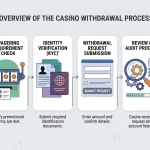
Separate the stages when reading a withdrawal policy. A pending period is time before the casino starts processing a request; a processing time begins once it acts on it. Specialist reviews describe a 24–48 hour pending period as common, but policies differ. First withdrawals may require enhanced identity checks, and a specialist review reports that casino approval can take from minutes to 48 hours. Ask what documents are required and whether the pending period can be cancelled or extended.
Also check the withdrawal ceiling. A specialist review reports AU$4,000 as a common weekly limit for standard players, while individual limits can differ; bonus-related winnings may have separate caps. Treat each figure as operator-specific, not a market-wide promise.
These details do not make offshore casino transactions protected under Australian consumer law: Australian players have minimal or no local protection if a dispute arises. The Interactive Gambling Act 2001 prohibits operators from providing real-money online casino games to people in Australia. Availability of a payment method is not an endorsement or assurance of a lawful service.
What is the legal status of playing at offshore RTG casinos from Australia?
Online casino operators are prohibited from offering their services to people in Australia under the Interactive Gambling Act 2001 and its amendments. Australian players are not explicitly criminalised for accessing offshore sites, but they have no local legal protection for disputes, and ACMA blocks access to illegal gambling sites.
Can I play RTG games for free?
Yes, RTG games support demo play, which lets you use a game without staking real money.
How do I verify the fairness of RTG games?
RTG games use a certified random number generator audited by independent testing agencies, including Technical Systems Testing (TST).
Do RTG casinos offer bonuses?
Yes, RTG casinos may offer welcome bonuses, free spins and reload promotions to Australian players. Bonus terms can include wagering requirements, and free-spin winnings may have separate conditions or withdrawal caps.
What happens if a casino closes while I have a balance?
Offshore casino disputes do not have local Australian legal protection. Recourse is typically to file a complaint with the casino’s foreign regulator.
Casino Apps

Australian mobile casinos: access, payments and play
Compare browser, shortcut and app access, then review funding, withdrawals, game performance and account limits...

Casino apps for Android in Australia: how access works
Compare browser access, downloadable apps and virtual-credit play, along with bonus conditions, the legal position...

iPhone Casino Access in Australia: Apps and Risks
Most play happens through a mobile website or PWA, with important distinctions around real-money access,...

Casino apps in Australia: access, rules and risks
Australian casino apps may offer virtual credits or real-money gambling, but the legal position and...

Instant Withdrawal Casinos in Australia: How Payouts Work
Withdrawal timing can depend on verification, bonus conditions and payment-method rules, not just how quickly...

International Casinos for Australian Players: A Guide
The guide separates offshore location and licensing claims from Australian rules, and outlines checks around...

Offshore Casinos for Australian Players: Access
Access from Australian phones commonly uses a browser or PWA, while licences and promotional terms...

Australian casino sites and slots: how play works
A practical guide to RNG results, game rules, bonus conditions, legal checks and payment details...
Golden Pokies Casino Australia: Law and Access
The guide separates operator restrictions from player liability and outlines offers, game terms, verification and...

House of Pokies Casino in Australia: Legal and Bonus Guide
The guide explains Australia’s rules for offshore casino services and outlines bonus conditions, verification, account...

Inclave Casinos in Australia: Rules and Access
Australia’s rules focus on the gambling service supplied, while listings and promotions alone do not...

iPad Casinos in Australia: Device Compatibility
A loaded casino page does not guarantee that its games work on an iPad; device...

Online Pokies E-Wallets in Australia: Payment Guide
E-wallet availability depends on the site and provider, while payment logos do not confirm eligibility...

Pocket Pokies Casino in Australia: Meaning and Safety
The guide distinguishes a named casino service from mobile pokies and explains what the wording...

Online pokies Australia: real-money no-deposit offers
Understand the difference between real-money offers and virtual credits, and how terms, mobile access and...

Real-Money Pokies on Android in Australia
A practical overview of app and browser options, free-play limits, offshore operator status and common...

Real-Money Pokies Apps in Australia: Mobile Guide
Mobile casino access may mean a browser site, a shortcut or an installed app, with...

Australian online pokies: legality, bonuses and withdrawals
A practical guide to checking offers, account access, payments and the legal limits on offshore...