Plinko Casino in Australia: 2026 Guide to Key Checks
 Available in AU
Game names and casino listings alone do not confirm how Plinko works, who made it or what rules and payment terms apply.
Table of Contents
- Plinko as a Slot: What the Label Does—and Doesn’t—Tell You
- Online Plinko and the Australian Legal Context
- Real-Money Play, Withdrawals and the Cost of Cashing Out
- What the Available Evidence Says About Plinko Games
- How to Read a Plinko Review Without Mistaking Claims for Evidence
- Plinko in Australia: What the 2026 Search Needs to Clarify
- Free Play and the Difference Between a Demo and a Bonus
- Crypto Payments and Plinko Scripts: Two Different Questions
- Bonus Terms: Wagering Multipliers and Game Contributions
- Lucky Plinko and Casino-Guru Searches: What Can Be Verified
- Pokies
Plinko as a Slot: What the Label Does—and Doesn’t—Tell You
The word “slot” often appears beside Plinko when people look for a casino-style game. It can be a convenient label for finding a game in a casino catalogue, but it does not, by itself, explain what the game does. A title such as “Gods of Plinko” may identify a product name; it does not tell you how a round works, how a result is determined or who made the software.
That distinction matters because casino listings and search results often place unlike products under familiar categories. “Plinko slot” may refer to a particular game, a style of game, or simply a phrase used by a site to organise its catalogue. “Plinko slot machine” can also be a way of describing the experience a person expects, rather than a precise technical description. The wording is not a specification.
A game name can be useful for locating a particular product, but it is only a starting point. Similar or identical words may appear in different titles, and a label can be used without establishing that products with that name share the same rules or software. The title alone also does not establish whether a game is a slot, a different kind of casino game, or a product presented as a hybrid. Those details need to come from information about the specific game, not from the wording attached to it.
Choosing a casino for Plinko in Australia means checking what is actually known about each option before you play. Use these concise verdicts as a starting point and review the relevant terms for yourself.
1. LuckyVibe
License: Curacao Gaming Control Board OGL/2023/176/0095 (Hollycorn N.V.) LuckyVibe lists a Curacao Gaming Control Board licence, OGL/2023/176/0095, held by Hollycorn N.V.
2. Golden Pokies
License: Curacao Golden Pokies is listed with a Curacao licence; no further operator details are provided here.
3. Vegaz Casino
License: Curacao OGL/2024/1335/0780 · Min. deposit: EUR 20 Vegaz Casino lists Curacao licence OGL/2024/1335/0780 and a minimum deposit of EUR 20.
4. Bizzo Casino
License: Curacao Gaming Control Board (TechSolutions Group N.V.) Bizzo Casino is listed under a Curacao Gaming Control Board licence held by TechSolutions Group N.V.
5. DragonSlots Casino
License: Curacao Gaming Authority (Jumpman Gaming Ltd) DragonSlots Casino lists a Curacao Gaming Authority licence held by Jumpman Gaming Ltd.
6. Kingmaker
Payout speed: crypto ~90 minutes, fiat 1-5 days · Min. deposit: A$30 Kingmaker lists a minimum deposit of A$30. Its stated payout times are around 90 minutes for crypto and 1–5 days for fiat.
7. Uptown Pokies
License: Curacao (operating since 2017) · Min. deposit: A$20 Uptown Pokies is listed as operating since 2017, with a Curacao licence and a minimum deposit of A$20.
8. GoldenCrown
License: Curacao Gaming Control Board OGL/2023/176/0095 (Hollycorn N.V.) GoldenCrown lists a Curacao Gaming Control Board licence, OGL/2023/176/0095, held by Hollycorn N.V.
9. Wild Tokyo
License: Curacao · Payout speed: crypto 30-60 minutes, fiat 1-5 days · Min. deposit: A$10 Wild Tokyo lists a Curacao licence and a minimum deposit of A$10. Its stated payout times are 30–60 minutes for crypto and 1–5 days for fiat.
10. Ricky Casino
Payout speed: crypto under 1 hour, PayID 1-3 business days · Min. deposit: A$20 (A$30 to qualify for the bonus) Ricky Casino lists a minimum deposit of A$20, or A$30 to qualify for the bonus. Its stated payout times are under an hour for crypto and 1–3 business days for PayID.
What the label leaves unanswered
The word “slot” does not confirm a game’s mechanics. It does not tell you what actions are available, how a result is produced, whether outcomes are generated by software or another method, or what a player needs to do during a round. Nor does it reveal the role of chance or whether different versions operate in the same way. A short listing may give a name and an image while leaving all of those points unclear.
The same caution applies to terms such as “Plinko Rush” or “Slot Temple Plinko”. They may help distinguish one listing from another, but their wording is not evidence about the product behind them. A familiar phrase can make a game seem easy to categorise; it cannot substitute for rules or technical details. If those details are not attached to the specific title, the label does not fill the gap.
The provider is another separate question. A name that sounds like a game brand does not identify the company that developed or supplied it. A casino’s catalogue may contain products from different providers, while a game name can be repeated, adapted or used in a listing without clearly identifying its origin. To establish a provider, look for a clear attribution tied to that exact title. Do not infer it from the casino hosting the listing or from the style of its artwork.
Lightning Link Online in Australia: Venue Play Explained
RTP is not a name tag
RTP, or return to player, is a theoretical measure that describes the share of wagers a game is designed to return over a very large number of plays. It is not a promise about what an individual will receive, and it cannot be inferred from a game’s title. A page describing a Plinko product as a slot does not, on that basis, provide its RTP.
KA Gaming’s slot RTP figures typically fall between 94% and 96%. That is a general range for KA Gaming slots, not a stated RTP for every title from that provider, and it does not establish the RTP of any particular Plinko game. It should not be attached to a Plinko title unless reliable information identifies that game as a KA Gaming product and gives its own figure. Even then, the game-specific information—not the broad provider range—would be the relevant detail.
A number presented without a clear connection to the exact game can be especially misleading. It may refer to a different title, a provider-wide range or an unrelated listing. The practical check is simple: does the information name the game and connect the figure to that game? If not, it does not answer the question for that title.
Treat names as identifiers, not explanations
The phrase “Plinko slots” may gather together games that a site or writer considers similar, but it does not prove that they share mechanics, software or performance. A “top” label is similarly a judgement, not a measurable property. It needs a stated basis before it can tell you anything useful. The same goes for a review: the title of the page does not establish what was examined or whether its claims apply to the exact game you have in mind.
Do
- Treat the game title as a name for identification
- Look for clear attribution to establish a provider
- Seek game-specific data for RTP and rules
Don’t
- Use the word “slot” to confirm game mechanics
- Infer the software provider from the game name
- Assume a provider’s general RTP range applies to every title
When a listing calls a product a Plinko slot, separate three things: the name used to identify it, the provider credited for it, and the information describing how it works. They are related only when the listing supplies evidence connecting them. A label can point you towards a product; it cannot do the work of a rules page, a provider attribution or a game-specific performance disclosure.
That is the useful limit of the slot label. It can describe how a product is filed or discussed, but it does not settle what the product is. For a particular Plinko title, the details have to stand on their own.
Online Plinko and the Australian Legal Context
A website can accept an Australian payment without being authorised to provide online casino games to people in Australia. Those are separate questions. A payment method may work across borders, but that does not change the rules governing the service itself.
Under Australia’s Interactive Gambling Act 2001, operators cannot provide real-money online casino services to people physically located in Australia. That prohibition covers casino-style games, including slots and table games. A Plinko game presented for real-money casino play falls within the online-casino context; a page describing it as “live”, “online” or a form of pokies does not alter the legal position.
Payments do not establish authorisation
Offshore online casinos often accept Australian payments while operating under licences issued elsewhere. That can make a site appear accessible to Australian users, but it is not evidence that the operator is authorised to offer online casino services here. A successful deposit, an Australian-dollar balance or a payment option familiar to local customers says something about how a transaction is handled—not whether the underlying service may lawfully be provided in Australia.
Mines Casino Game in Australia: What’s Verified
The distinction matters because a payment screen can be more visible than the legal terms. A site may welcome Australian customers, display local currency or refer to Australian players in its promotions. None of those features turns an offshore licence into Australian authorisation. Nor does a licence from another jurisdiction override the Australian restriction on providing real-money online casino games to people in Australia.
The same point applies when a site lists Plinko alongside other casino games. The game’s name, presentation or location on a website does not determine whether the operator is authorised. If the service is an online casino offering real-money play to people physically in Australia, the relevant issue is the service being offered—not the wording used to describe it.
What the law means for players
The legal restriction is directed at operators providing prohibited online casino services. Players are not criminalised simply for using an offshore site. That distinction should not be mistaken for approval of the service, a guarantee of access or a finding that the operator is trustworthy. It means the legal treatment of an operator and the legal treatment of an individual player are not the same.
A search for an online Plinko casino may therefore lead to sites that accept Australian customers without being authorised to provide online casino services in Australia. Whether a particular site processes payments is not a reliable shortcut for judging its legal status. The operator’s offshore licence, if it has one, describes its position under another jurisdiction’s rules; it does not establish permission to serve people in Australia.
Legal Restriction
Under Australia’s Interactive Gambling Act 2001, operators are prohibited from providing real-money online casino services to people physically located in Australia.
This is also why labels such as “Australian casino” can be misleading when they refer only to customers, currency or payment options. A website might be aimed at Australians in a commercial sense while remaining an offshore operation. The wording does not change where the operator is licensed or the Australian law that applies to services offered to people here.
Read claims in their proper context
When a site claims that it is “licensed”, check what that claim actually refers to. It may identify an offshore regulator, rather than Australian authorisation. A licence statement should not be treated as proof that real-money casino games may be offered to Australian residents. Likewise, customer support that answers Australian enquiries or terms that mention Australian users do not settle the legal question.
The distinction is relevant whether a page promotes a Plinko-style game on its own or places it within a broader casino catalogue. “Online casino with Plinko” describes a combination of products, not a regulatory status. A payment facility and a game catalogue may make the service appear available, but availability and authorisation are not interchangeable.
For Australian readers, the practical point is straightforward: an offshore site’s willingness to take a payment does not mean it is permitted to provide real-money online casino play in Australia. The Interactive Gambling Act 2001 restricts that service, while players themselves are not criminalised for using offshore sites. Keeping those two parts of the legal picture separate helps avoid a common mistake: treating access as proof of authorisation.
Live Baccarat Online in Australia: Rules and Risks
Real-Money Play, Withdrawals and the Cost of Cashing Out
A balance shown on an offshore gambling site is not necessarily an amount you can withdraw. The practical test is what the withdrawal rules allow you to take out, what checks must be completed first, and whether any part of the balance is still subject to bonus conditions. These details matter more than the label attached to a Plinko-style game.
Offshore sites commonly set minimum withdrawal thresholds between A$75 and A$150. If your eligible balance falls below the threshold, you may not be able to request a payout yet. A displayed balance can therefore be real in the limited sense that it appears in your account, while still being unavailable for immediate withdrawal. Before depositing, read the withdrawal terms and check whether the threshold applies to each request or to the account balance. Do not assume that a small balance can be cashed out simply because it is visible.
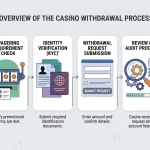
The threshold is only one condition. A first cashout commonly triggers KYC, short for know-your-customer identity checks. A site may ask for documents such as a passport or driver’s licence, along with a utility bill. The purpose is to establish who owns the account and confirm identity details. Until the operator accepts the documents, a withdrawal may remain pending. That can be an unwelcome surprise if you have treated the first payout as a routine transfer rather than a verification step.
Check what documents are accepted and how they must be submitted before you rely on a balance. Names and other account details should match the documents you provide. If a site’s requirements are unclear, or if you cannot find a route for asking about a delayed verification, that uncertainty is relevant to your decision. A payment method that lets you deposit does not, by itself, tell you how a later withdrawal will work.
Withdrawal Verification
- Check if the balance meets the minimum withdrawal threshold (typically A$75–A$150)
- Verify if any part of the balance is subject to bonus wagering conditions
- Prepare identity documents (passport, driver’s licence, utility bill) for KYC checks
- Confirm that account details match the provided documentation
Bonus-derived funds require a separate calculation. They are not cash simply because they appear alongside deposited funds in the account. They may be subject to wagering checks: conditions requiring bets to be placed before bonus funds or winnings connected to them become withdrawable. A specialist gambling review reports requirements in the range of 30–50 times, but that is a report of terms described by that source, not a fixed rule for every operator or offer. The exact wording attached to a particular promotion is what matters.
Read the terms for the offer you are considering, not a general summary of bonus conditions. Check what amount the wagering requirement is calculated against, which bets count, and what happens if you withdraw before satisfying the conditions. A bonus may make the displayed figure look larger while adding steps between that figure and money you can take out. If the terms do not explain how the balance is divided between deposited funds, bonus funds and winnings, do not assume the most favourable interpretation.
This is particularly important when an offer is described as a no-deposit bonus. The absence of an initial deposit does not make bonus-derived funds unrestricted or withdrawable. The offer may still come with wagering conditions and other rules. Treat any promotional balance as conditional until you have read the terms and know what must happen before a withdrawal is permitted.
Low-Volatility Slots in Australia: What They Mean
A useful way to assess the amount at stake is to separate three figures: your deposited money, any bonus balance, and the portion currently eligible for withdrawal. They may not be the same. Then compare the eligible amount with the site’s minimum withdrawal threshold and check whether first-cashout KYC remains outstanding. If one of those conditions is unmet, the displayed total may overstate what you can access now.
Real-money online casino services are prohibited when offered to people in Australia. This practical discussion is not a recommendation to use an offshore casino or to deposit money there. If you are assessing a balance on such a site, avoid treating it as income or as money available for ordinary expenses. Gambling can cause serious harm, particularly for people who are vulnerable to it. Anyone who is under 18 should not gamble.
What the Available Evidence Says About Plinko Games
A Plinko title appearing in a casino catalogue does not, by itself, tell you how that particular game works. The name cannot establish its rules, odds or software provider, and those details should not be inferred from the word “Plinko” or from the way a game is presented. Two titles using similar labels are not necessarily the same product.
That distinction matters when you are trying to understand what a specific game offers. A description may use familiar language without identifying the game’s underlying mechanics. Treat the title as a name, not as a technical specification: it cannot tell you how an outcome is determined or what return to expect. Those are separate questions that require information tied to the particular game.
Victorian Pokies
Victorian players lost $2.6 billion on poker machines over a year, including over $21 million from a single hotel in Melbourne’s north.
There is, by contrast, a documented account of losses on Victorian poker machines. Gamble.com.au reported that Victorian players lost $2.6 billion on pokies over a year, more than $44.7 million above the figure for 2015. The report also said the Epping Plaza Hotel in Melbourne’s north generated more than $21 million from 100 machines over the preceding year. These are reports about poker-machine figures, not evidence about Plinko games. The distinction is worth keeping clear: numbers attached to one form of gambling cannot fill gaps about another.
The scale of those reported figures gives context to the debate over poker-machine settings. Senator Nick Xenophon and MP Andrew Wilkie proposed a $1 limit on bets placed on poker machines. That was a proposal, not a statement of a rule in force. It concerned machine betting and does not establish anything about the design or operation of a Plinko title.
For someone looking into a Plinko-branded game, the useful point is not that the name proves it resembles a pokie, or that poker-machine data can be transferred to it. Neither conclusion follows. The Victorian figures describe a different category of gambling, while the proposed bet limit was directed at poker machines. Keeping those categories separate avoids making an apparently precise comparison from unlike information.
Pokies Tips and Tricks: What Actually Helps
The word “game” can also make a product sound more fully described than it is. A label may tell you how a provider or platform names a title, but it does not automatically answer practical questions about its rules or mathematical settings. If those details are not clearly identified for the exact title, a general description cannot substitute for them. Nor does a familiar-looking name show who made the software.
The same care applies to comparisons with other gambling products. Poker-machine loss figures measure reported losses in that setting; they do not reveal the chance of a Plinko outcome, a game’s return, or the experience of an individual player. Likewise, a political proposal about poker-machine bets is not a measure of Plinko risk. The figures are consequential, but their scope is specific.
So the evidence supports a narrow conclusion: Victorian poker-machine losses have been reported at substantial levels, and a bet-limit proposal was made in response to concerns about machines. Those facts provide context for discussion of pokies. They do not supply missing specifications for Plinko. To understand a named Plinko game, you need details that identify that product rather than assumptions borrowed from its label or from unrelated gambling data.
3-Reel Slots in Australia: Rules, RTP and Play
How to Read a Plinko Review Without Mistaking Claims for Evidence
A review can describe a game, repeat an operator’s claims or offer an opinion. Those are different kinds of information, and confident wording does not make them equivalent. Treat statements about fairness, safety or a supposed connection to a public figure as claims to verify—not as findings established by the review itself.
Start with what the review identifies. Does it give the exact game title and say who made it, or does it use “Plinko” as a broad label? A name such as Plinko Rush, Plinko Verde or Plinko Deluxe may help identify what a page is discussing, but the name alone does not confirm the game’s provider, rules or technical properties. Likewise, a result presented as a MrBeast-branded casino game does not establish that MrBeast created, endorsed or is connected to it. Look for evidence of that relationship from the people or organisations said to be involved.
Attention: Adjectives like "fair," "safe," or "trusted" in a review are opinions unless the reviewer points to specific, independently checkable material.
Then check whether the review shows how it reached its conclusions. A useful account distinguishes direct observation from information copied from a game page or supplied by an operator. It should identify the material being reviewed clearly enough for you to compare descriptions, and explain what was tested or examined. A screenshot or an assertion that a game was “verified” is not, by itself, an explanation of the verification process.
Pay attention to the difference between a measurable statement and an adjective. “Fair,” “safe” and “trusted” are conclusions; on their own, they tell you neither what was checked nor by whom. A review that makes such claims should point to specific, independently checkable material. If it does not, the wording is evidence of the reviewer’s opinion, not proof of the underlying claim.
The same caution applies to pages describing a free version or calling themselves a comprehensive Plinko casino review. Those labels do not establish what the page actually examined. Check whether it describes a particular game or merely discusses a category, and whether its claims relate to the game, the site hosting it or both. A detailed review of one does not automatically verify the other.
Finally, consider the review’s date and incentives. Game information and operator terms can change, while a review may remain online unchanged. Look for a clear publication or update date and notice whether the page explains commercial relationships that could affect its recommendations. If key details cannot be checked independently, the honest reading is that the review has not established them.
Plinko in Australia: What the 2026 Search Needs to Clarify
For anyone in Australia looking into Plinko offered for real money, the relevant federal regulator is the Australian Communications and Media Authority (ACMA). It enforces the Interactive Gambling Act 2001 and monitors compliance with federal interactive-gambling rules. A site being visible online or accepting Australian payments does not, by itself, establish that its services comply with those rules.
High-Volatility Slots in Australia: What to Know
ACMA can ask Australian internet service providers to block websites that provide prohibited interactive gambling services or advertise them in Australia. Blocking is an enforcement measure, not a certification process: a site that remains accessible has not thereby been approved or found lawful. Nor does a site’s own description of its status replace the rules ACMA enforces.
The scale of enforcement is reflected in reported totals. Since November 2019, ACMA has blocked more than 1,455 illegal gambling and affiliate websites following enforcement action. There are also differing published counts for services that have left the Australian market since ACMA began enforcing the rules in 2017: one figure is more than 210, while another is over 190. Those totals should not be silently combined or treated as identical measures.
These figures describe enforcement activity across gambling and affiliate websites; they do not establish whether a particular Plinko-branded service has been assessed, blocked, or withdrawn. A brand name can also appear on more than one site, so matching a name alone is not enough to identify the service concerned. The useful distinction is between a general enforcement record and a specific status claim about a particular website.
That matters when comparing information about Plinko in Australia with material aimed at other countries. Rules and enforcement arrangements differ by market; a statement about casino access in Canada, for instance, does not settle the position for someone physically in Australia. For a specific service, look for the exact website identity and any relevant ACMA notice rather than relying on a broad label or a claim that a site serves Australian customers.
ACMA Enforcement
- ACMA monitors compliance with the Interactive Gambling Act 2001
- Over 1,455 illegal gambling and affiliate websites have been blocked since November 2019
- Between 190 and 210 services have left the Australian market since 2017
- Accessibility of a site does not imply it has been approved or found lawful
Regulatory enforcement does not remove the personal risks of gambling. Gambling can cause serious harm, particularly to vulnerable people, and anyone gambling must be at least 18. ACMA’s role is to enforce federal interactive-gambling rules; its actions should not be read as an endorsement of any Plinko game or casino.
Free Play and the Difference Between a Demo and a Bonus
A demo and a bonus can both be described as “free”, but they are not the same thing. Demo play uses no cash balance and does not create withdrawable winnings. It can show how a game behaves, but it does not tell you what a cash offer’s conditions are.
A bonus is different: it is credit attached to an account under stated terms. Bonus funds are not cash, and any winnings derived from them may remain unavailable for withdrawal until wagering conditions are met. “Free spins” can also be part of a bonus offer; the label alone does not explain what happens to any resulting winnings. The terms need to say how the credit works and what conditions apply.
The arithmetic can be substantial. One specialist review gives the example of a $100 bonus with a 40x wagering requirement: the player would need to place $4,000 in bets before bonus-derived winnings could be withdrawn. That is a specific example reported by that kind of source, not a universal condition. An offer with a different multiplier, or different rules for counting eligible bets, would produce a different result.
When you see a free-play option, check whether it is a demo or promotional credit before treating it as a way to win money. A demo should not be confused with an offer that has wagering requirements; nor should a bonus be read as a cash payment. Free wording does not remove the conditions.
Video Slots in Australia: How Mobile Play Works
People searching for Plinko in a free format may be looking to try a demo, while searches mentioning spins may point to promotional credit. Those are separate arrangements, and neither phrase establishes that winnings can be withdrawn. Do not assume that an offer is suitable simply because it is described as free. Gambling is for people aged 18 or older, and it can cause serious harm, particularly for vulnerable individuals.
Crypto Payments and Plinko Scripts: Two Different Questions
A cryptocurrency payment and a Plinko script refer to different parts of an online service. Crypto describes how value may be transferred; a script is software or code associated with building or running a game. Neither term, by itself, tells you who operates a site, whether a particular game is fair, or whether the service is lawful for someone in Australia.
A site may advertise Plinko play alongside crypto deposits or withdrawals. That pairing is a payment option, not evidence about the game’s mechanics or the operator’s reliability. Cryptocurrency transfers can also involve costs that are easy to miss when attention is fixed on speed. A specialist review reports that crypto withdrawals can clear faster than other methods, while network fees and conversion spreads may reduce what reaches the player. The amount received matters more than the speed shown on a payment page.
“Plinko script” can mean code used to create or operate a Plinko-style game. Seeing that phrase in a description does not establish which software is running, who wrote it, or how outcomes are generated. A claim that a game is provably fair would need evidence about the system and a way for a player to check it; the word “script” alone supplies neither. Nor does using a familiar payment method verify the software.
Crypto vs. Scripts
Cryptocurrency refers to the method of transferring value, while a script is the software code used to run the game. Neither a specific payment method nor the use of a “script” label verifies the fairness, lawfulness, or reliability of a service.
Keep the checks separate: payment information concerns transfers and deductions, while software information concerns the game itself. A crypto option does not make a service safer, and a script label is not a certification. In Australia, the availability of a payment route does not change the legal position on providing real-money online casino services to people in the country.
Bonus Terms: Wagering Multipliers and Game Contributions
A bonus is not the same as cash. Bonus funds, and any winnings derived from them, can remain restricted until you meet the wagering requirement: the amount of qualifying bets specified in the offer’s terms. A “no-deposit” label does not remove those conditions or make bonus funds immediately withdrawable.
The arithmetic can be substantial. A specialist review gave the example of a $100 bonus with a 40x wagering requirement: you would need to place $4,000 in qualifying bets before bonus-derived winnings could be withdrawn. That is an illustration from one review, not a standard that applies to every offer. The operator’s own terms determine the multiplier, which funds it applies to and which games count.
Game contribution is a separate condition. It sets how much of a bet on a particular game counts toward the requirement. A specialist review reported an example in which blackjack counted for only 10%. If a game contributes less than its full stake, reaching the stated wagering total can take more betting than the headline multiplier suggests. Do not assume that a Plinko game contributes fully—or is eligible at all—unless the specific terms say so.
Before accepting any offer, check the calculation base, eligible games, contribution rates and any other conditions attached to bonus-derived winnings. A large headline bonus can be less useful than it appears when only some bets count. The terms, not the promotional label, determine what you must do.
Pokies & Casino Games in Australia: Slots and Tables
These conditions do not change the Australian legal position: operators are prohibited from providing real-money online casino services to people in Australia. This is information about how wagering terms work, not an invitation to take up an offer. Gambling can cause serious harm, particularly for vulnerable people; gambling is for adults aged 18 and over.
Lucky Plinko and Casino-Guru Searches: What Can Be Verified
A page or product called Lucky Plinko is not identifiable from its name alone. The label could refer to a game, an app, a casino promotion or a website, and those are not interchangeable. Before relying on a result, check whether it names the actual operator and explains who supplies the game. If those details are absent, the name does not tell you who is responsible for the service.
A UK-focused page is not evidence that a service is suitable for someone in Australia. Its descriptions may relate to different terms, access arrangements or audiences. Treat location labels as context, not as a recommendation. The relevant question is whether the information applies to the service and circumstances you are considering—not whether the page uses familiar wording.
A Casino Guru result should be read as a publication or review source, not as proof that a particular Plinko product is fair, safe or appropriate. Separate what the page documents from what it concludes. A clear distinction between named facts and the reviewer’s assessment makes it easier to judge how much weight to give the article.
You can also check whether the page identifies the product precisely, dates its claims and links them to information that can be independently checked. If it uses a brand name without establishing which operator or game it means, there is little basis for carrying its conclusions over to another service.
None of this makes a recommendation. In Australia, real-money online casino services are prohibited for operators to provide to people in the country; a familiar brand or review label does not change that. Gambling is for adults aged 18 or older, and it can cause serious harm to vulnerable people.
Pokies

3-Reel Slots in Australia: Rules, RTP and Play
A practical guide to three-reel slots, bonus mechanics, RTP, paytables and the rules that apply...

Five-Reel Slots in Australia: Bonuses, RTP and Play
Understand bonus triggers, RTP information, free-play options and what to check in a game’s rules...
Seven-Reel Slots in Australia: Bonuses, RTP and Rules
A practical guide to bonus mechanics, paytables, RTP, free play and the limits of identifying...

Bonus-buy slots in Australia: features and legality
Learn what direct entry to a slot feature means, how to check game details, and...

High-Volatility Slots in Australia: What to Know
High volatility can mean longer stretches without meaningful payouts, but it cannot predict when a...

Low-Volatility Slots in Australia: What They Mean
Low volatility describes a pattern of relatively frequent, modest wins, not a promise that any...

Best Pokie Machines to Play in Australia: A Guide
Understand the rules for online play, the differences between machines and the factors that can...

Progressive Jackpot Slots: How Pools and Triggers Work
Progressive jackpots depend on wager contributions, game-specific triggers and eligibility rules, so pool size alone...

RTP Slots in Australia: How Return to Player Works
RTP is a long-run statistical measure, not a forecast for an individual session or a...

Video Slots in Australia: How Mobile Play Works
A practical overview of mobile play, free-spin features, RNG independence, RTP and the limits of...

Casino Dice Games in Australia: Formats and Rules
A practical guide to dice-based game formats, the craps table, rules to check and the...

Crash Casino Games in Australia: Law and Risks
A practical look at offshore casino rules, crash-game mechanics, crypto withdrawals, free play and wagering...

Lightning Link Online in Australia: Venue Play Explained
The guide distinguishes venue-machine play from online casino listings and explains free credits, game features...

Live Baccarat Online in Australia: Rules and Risks
This guide explains Australia's online casino restriction and the practical differences between live and RNG...

Live Blackjack Online Casinos in Australia: Legal Context
Live dealer presentation does not change blackjack’s classification or make an Australian-licensed online casino available....

Live Roulette in Australia: Dealers, Rules and Law
A practical overview of Australian online-gambling restrictions, live-table rules, roulette odds, and what English-speaking dealers...

Mines Casino Game in Australia: What’s Verified
The guide checks what can be established about Mines access, demos, bonuses and withdrawals, while...

Pokies Tips and Tricks: What Actually Helps
A practical guide to randomness, game selection and play habits—without treating tips as a way...

Real-Money Casino Table Games in Australia: How They Work
A guide to live and software-generated formats, familiar table-game mechanics, and what the available information...