VPN-Friendly Casinos in Australia: Access Explained
 Available in AU
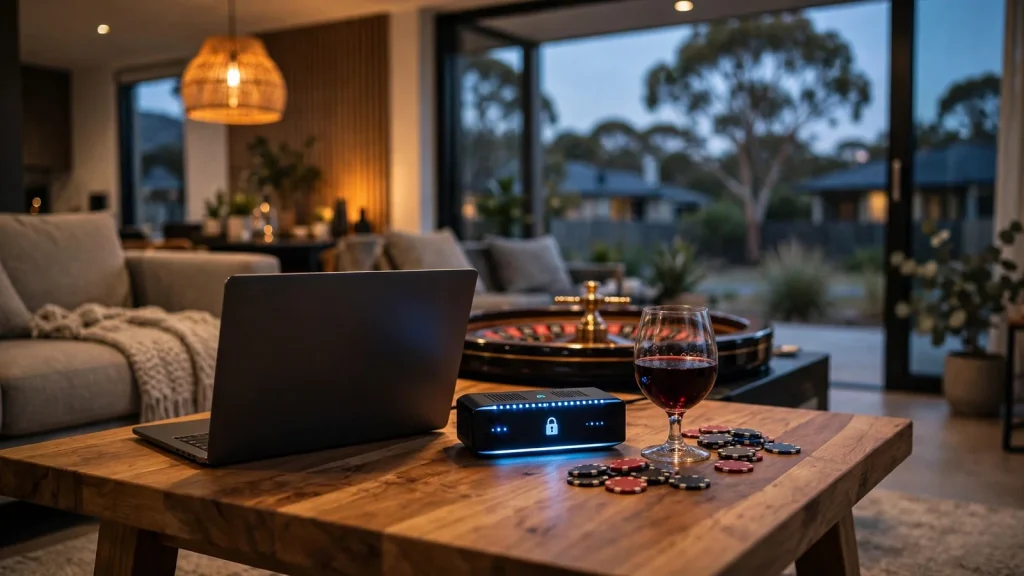
A VPN can route traffic through an external server, but that network change does not itself remove restrictions on a casino site.
Table of Contents
- What a VPN changes—and what it leaves unchanged
- How to assess an offshore casino’s licence
- Australia’s rules on offshore online casinos
- Crypto payments do not remove the Australian restrictions
- Before you try to play through a VPN
- Bitcoin casino searches: check the payment rules first
- What a VPN can—and cannot—do for casino access
- A casino’s VPN policy is not the same as access
- Searching for Shuffle Casino and VPN access
- VPN access to online slots does not change the rules
- Access Safety
What a VPN changes—and what it leaves unchanged
When a casino website does not load, the cause may be a block at the network level rather than a problem with the site itself. One method used by internet service providers (ISPs) is DNS blocking. DNS, or the Domain Name System, matches a website’s domain name with the address needed to connect to it. If the ISP prevents that name from being resolved, your browser cannot reach the site through its ordinary connection.
A virtual private network (VPN) changes how your internet traffic travels. It encrypts the connection between your device and a VPN server, then routes the traffic through that server. With the VPN active, your ISP sees encrypted traffic going to the VPN server rather than a direct request to a casino domain. If the server is outside Australia, the casino may also see the server’s IP address instead of your Australian one. This can get around a DNS restriction imposed by your ISP.
That is a change in the route and the network details visible to different parties. It is not the same as removing every restriction on the site. A VPN can affect whether a domain resolves over your connection; it cannot determine whether a casino accepts customers from Australia, or whether its own systems permit a connection from a particular address.
If you’re considering a casino while using a VPN, check the operator’s licensing details and payment information before deciding. This list gives you a concise reference point, but the information provided does not establish whether any operator permits VPN use.
1. LuckyVibe
License: Curacao Gaming Control Board OGL/2023/176/0095 (Hollycorn N.V.) You can note the listed Curacao Gaming Control Board license, OGL/2023/176/0095, held by Hollycorn N.V.
2. Golden Pokies
License: Curacao The available detail for you to consider is a Curacao license; no further operator information is provided here.
3. Vegaz Casino
License: Curacao OGL/2024/1335/0780 · Min. deposit: EUR 20 You can check its Curacao license, OGL/2024/1335/0780, and its EUR 20 minimum deposit.
4. Bizzo Casino
License: Curacao Gaming Control Board (TechSolutions Group N.V.) The listed licensing detail for you is a Curacao Gaming Control Board license held by TechSolutions Group N.V.
5. DragonSlots Casino
License: Curacao Gaming Authority (Jumpman Gaming Ltd) You can note its Curacao Gaming Authority license, held by Jumpman Gaming Ltd.
6. Kingmaker
Payout speed: crypto ~90 minutes, fiat 1-5 days · Min. deposit: A$30 You have a stated minimum deposit of A$30 to consider. The listed payout estimates are around 90 minutes for crypto and 1–5 days for fiat.
7. Uptown Pokies
License: Curacao (operating since 2017) · Min. deposit: A$20 You can take into account its Curacao license, its operation since 2017, and its A$20 minimum deposit.
8. GoldenCrown
License: Curacao Gaming Control Board OGL/2023/176/0095 (Hollycorn N.V.) You can note the listed Curacao Gaming Control Board license, OGL/2023/176/0095, held by Hollycorn N.V.
9. Wild Tokyo
License: Curacao · Payout speed: crypto 30-60 minutes, fiat 1-5 days · Min. deposit: A$10 You can consider its Curacao license, A$10 minimum deposit, and stated payout estimates: 30–60 minutes for crypto and 1–5 days for fiat.
10. Ricky Casino
Payout speed: crypto under 1 hour, PayID 1-3 business days · Min. deposit: A$20 (A$30 to qualify for the bonus) You can consider the A$20 minimum deposit, or A$30 to qualify for the bonus. The listed payout estimates are under an hour for crypto and 1–3 business days for PayID.
Three separate checks
It helps to separate three questions that are easily blurred together:
- Can your connection reach the website? An ISP-level DNS block can prevent the domain from resolving. A VPN may route the connection in a way that avoids that particular restriction.
- Will the casino accept the connection? A casino can run its own checks after your traffic reaches its systems. Many casinos use IP geolocation services, and known VPN server addresses may be identifiable. A page loading is not proof that an account, deposit or game will be available.
- Does the route make using the site lawful? No. Changing the apparent network location does not change the legal status of the service or make a VPN a legal exemption. The lawfulness of the service is a separate question from whether your browser can reach it.
This distinction matters when people look for VPN-friendly online casinos or wonder whether a VPN can be used for casino games. “VPN-friendly” is not a technical guarantee that every server will work, and it does not establish that an operator permits VPN use. At most, the phrase suggests that access may be possible under some circumstances. The casino’s systems can still reject a connection, and its terms may set their own conditions.
Nor does a successful connection show that the operator is safe or legitimate. Network access tells you only that a page has loaded through a particular route. It does not verify who operates the site, how it handles accounts, or whether you can rely on its promises. Those are separate matters, not functions a VPN performs.
There is also a difference between masking an Australian IP address and concealing every aspect of your identity or location. The VPN changes the network address presented through its server, but it does not itself settle how the casino assesses a visitor. Its own checks may consider the IP address and may recognise addresses associated with VPN servers. The result can vary by connection and by the casino’s systems.
A VPN can therefore be relevant to a narrow access problem: an ISP’s DNS settings prevent a domain name from resolving, and routing encrypted traffic through a server elsewhere may avoid that restriction. It cannot turn a blocked site into an approved one, compel a casino to accept the connection, or answer whether using the service is lawful.
The practical point is simple: treat network access, the casino’s own rules, and legal status as separate issues. A site opening in your browser settles only the first, and even then only for that connection. The technology changes how traffic is routed and which IP address the site may see; it leaves the operator’s checks and the law unchanged.
VPN and Access
- A VPN changes the network route and IP address, not the legal status of the service.
- Network access does not guarantee that a casino accepts Australian customers or permits VPN use.
- Loading a page does not verify the operator’s legitimacy or safety.
- ISP DNS blocks are a narrow access problem that a VPN may bypass, but it cannot compel a casino to honor a transaction.
How to assess an offshore casino’s licence
For an Australian player, “offshore” describes an online casino that does not hold an Australian licence. It does not, by itself, tell you whether the operator holds a licence somewhere else, whether that licence is genuine, or what protection it offers. Those are separate questions—and a VPN cannot answer them.
A VPN may get around a block applied at the network level, but that only changes how your connection reaches a website. It does not make the operator legitimate, establish that the casino is safe, or turn its services into something authorised for Australian players. A site’s claim that it is VPN-friendly is not evidence of a valid licence. Nor does a licence from another jurisdiction amount to an Australian online casino licence.
Check the regulator, not just the badge
Offshore casino websites may display a regulator’s name or a licence badge in the footer. Treat that as a lead to verify, not as proof. Look for the legal name of the company that operates the casino, the regulator it says issued the licence, and the licence number. Then check those details against information published by the regulator itself.
The details should line up: the regulator’s record should identify the same company and licence, and the licence should be current. A badge that cannot be matched to a regulator’s record, a number that leads nowhere, or a company name that differs from the one on the casino’s terms leaves an important gap. If the regulator’s register does not let you confirm the claim, the claim is not independently verified.
Secure Online Casinos in Australia: What Security Means
Also check what the licence actually covers. A licence may be associated with a company without clearly establishing that it covers the website you are viewing or the gambling service being offered. Read the casino’s terms and the regulator’s entry together, and compare the operator name, domain and licence status. A polished footer cannot settle a mismatch.
Jurisdiction matters, but it is not permission
Licences are not interchangeable. In comparative assessments, licences associated with the Malta Gaming Authority, Gibraltar, the Isle of Man and Alderney are generally regarded as carrying more weight than a Curacao licence. That relative standing can help you assess the oversight claimed by an offshore operator; it does not certify a particular casino or guarantee that you could recover money in a dispute.
The regulator’s identity matters because a licence is only useful to assess when you can establish who issued it and what oversight applies. Find out whether the regulator provides a way to check the licence and whether the record corresponds to the operator. If the website offers only a generic seal, or directs you back to its own page as the sole proof, you have not independently confirmed the licence.
A regulator’s reputation should not be confused with Australian authorisation. Even a current, verifiable foreign licence does not mean the casino holds an Australian licence. A VPN-friendly casino website may still be an offshore casino in this sense, and its licence does not change that classification.
Verifying a Licence
Identify the details
Find the legal company name, the regulator, and the licence number displayed in the casino’s footer.
Consult the regulator
Visit the official website of the named regulator to search their public register.
Match the information
Ensure the company name, licence number, and current status on the register match the details provided by the casino.
Review the scope
Confirm that the licence actually covers the specific website and gambling services you are using.
Read the terms alongside the licence
The licence is only one part of the picture. Read the terms that identify the operator and explain which rules govern the account. Check whether the legal company named there matches the licence information, and whether the website’s claims about its regulator are consistent across its pages. If key details conflict, or the operator’s identity is difficult to establish, do not treat the badge as reassurance.
Be cautious about treating access as evidence of approval. A site loading through a VPN says nothing about the operator’s licence status. Similarly, a casino accepting an account registration does not verify its regulatory claims. Network access, a foreign licence and Australian authorisation are different matters; one does not establish the others.
This distinction also applies when a site presents itself as suitable for VPN use. The phrase may describe a technical claim about access, not a regulatory status or a promise of consumer protection. Do not infer that the operator permits your location or that its licence protects you simply because the site opens.
This page is affiliate-based and includes sponsored links. That commercial relationship is not a substitute for checking an operator’s licence directly with the named regulator. For any offshore casino, the useful test is whether the company, licence and regulator can be identified and independently matched—and whether you understand that a foreign licence is not an Australian one.
$10 Minimum Deposit Pokies in Australia: How It Works
Australia’s rules on offshore online casinos
Australia does not issue licences for online casinos. The legal starting point is the Interactive Gambling Act 2001, which makes it unlawful for operators to provide real-money online casino games to people in Australia. That covers casino-style games such as slots, poker and table games when offered to customers located here. An offshore casino may hold permission from a regulator elsewhere, but that does not amount to an Australian online casino licence or authorise it to provide those services to Australian residents.
The Act is directed primarily at the businesses providing prohibited services, rather than making it an offence for an Australian player simply to use an offshore site. That distinction matters, but it should not be mistaken for approval or a guarantee of access. The operator’s conduct and a player’s decision to visit a site are separate issues. A foreign licence does not displace Australian law, and a site being reachable does not establish that its service is permitted.
ACMA’s enforcement role
The Australian Communications and Media Authority (ACMA) oversees compliance with federal interactive gambling rules and enforces the Act. Its work includes investigating offshore operators suspected of offering prohibited services to people in Australia. When a site is identified as providing a prohibited gambling service, or advertising one here, ACMA can ask Australian internet service providers to block access to it.
That measure acts at the network level: an ISP may be instructed to prevent customers from reaching a domain. It does not itself decide whether an offshore operator is honest, whether a player’s account will be honoured, or whether a foreign regulator can resolve a dispute for an Australian customer. A blocked site and an operator under investigation are enforcement matters; neither should be treated as a consumer endorsement or a safety assessment.
ACMA Enforcement
Since November 2019, ACMA has blocked over 1,455 illegal gambling and affiliate websites, and has been associated with over 190 to 210 offshore services leaving the Australian market.
ACMA says enforcement actions have resulted in more than 1,455 illegal gambling and affiliate websites being blocked since November 2019. The figure reflects accumulated action over time, not a fixed count of sites that will remain blocked or a complete measure of every prohibited service. Domains and access routes can change, so a block at one address does not mean the underlying operator has become lawful or has ceased operating.
ACMA’s enforcement has also been associated with offshore services leaving the Australian market. The reported total is not consistent across accounts: one gives more than 210 departures since enforcement began in 2017, while another reports more than 190 over the same period. In either case, a service’s withdrawal indicates a response to enforcement; it does not create a local licensing system.
What the rules mean in practice
“Offshore” describes a casino operating from outside Australia without an Australian online casino licence. It does not, on its own, tell you whether the operator has a licence abroad, whether that licence is current, or what recourse would be available if a payment or account dispute arose. Those are separate questions from whether the operator may legally offer online casino games to people in Australia.
The distinction also explains why a website’s availability can change. ACMA may act against a site, and an ISP block can make its domain inaccessible through that provider. A site may also be unavailable for reasons unrelated to an ACMA action. Access at a particular moment is therefore not evidence that the service has been approved under Australian law, while inability to reach it does not by itself reveal the full reason.
Casinos not on BetStop in Australia: risks and checks
For readers considering an offshore casino, the practical legal point is not that a technical workaround changes the rules. The Act’s restriction concerns the operator’s provision of the service to people in Australia. Altering how a connection reaches a website cannot grant the operator an Australian licence or change the location-based rule. Nor does a casino’s foreign authorisation transform it into a locally licensed online casino.
This page is affiliate-based and may include sponsored links. Affiliate relationships do not change the status of online casino services under Australian law, and a link or listing should not be read as confirmation that an operator is authorised to provide casino games to Australian residents.
Crypto payments do not remove the Australian restrictions
A casino described as “VPN-friendly” may sound accessible from Australia, and a crypto deposit may seem like a way around payment barriers. Neither description changes the central issue: cryptocurrency is not an allowed payment method for gambling in Australia. Using a VPN or choosing a digital currency does not make a prohibited gambling payment lawful.
Crypto can also create a misleading sense of distance from the operator. A transfer may not look like a card transaction, but the payment method does not alter what the service is or where it is being offered. If an offshore casino accepts Australian customers for real-money games, paying with cryptocurrency does not turn that offer into a permitted one. Nor does a VPN make the operator legitimate, protect your funds or guarantee that a withdrawal will be honoured.
Payment Risks
Cryptocurrency is not an allowed payment method for gambling in Australia, and using a VPN does not make prohibited gambling payments lawful.
“No-KYC” claims need similar caution. KYC means “know your customer”: checks used to establish a customer’s identity. A site’s claim that it offers gambling without these checks is not proof that it will never ask for documents, or that the service is safe or lawful. The claim may describe an advertised sign-up process, not what happens when you try to withdraw funds or when the operator applies its own terms. Do not treat the absence of a visible identity check as consumer protection.
The combination of crypto, a VPN and no identity checks can be presented as a route to fewer barriers. In practice, each claim leaves important questions unanswered: whether the casino accepts customers in Australia, whether its terms permit VPN use, what checks it may require, and what happens if it refuses a payment or withdrawal. A technical route to a website does not settle any of those questions.
Card payments are not a reliable alternative. A specialist review reports that Australian banks may decline credit-card deposits connected with online gambling under the Interactive Gambling Act 2001. That does not mean every transaction will be treated the same way; it does mean you should not assume that a card deposit will go through. Trying another payment route does not change the underlying restriction.
Before sending money, consider what you would be relying on if a transaction were delayed, rejected or disputed. Crypto transfers can be difficult to reverse, and a VPN does not provide a way to recover funds from an offshore operator. Avoid making a deposit on the assumption that a payment method, a VPN connection or a “no-KYC” label provides legal cover or guarantees access to your money.
$5 Minimum Deposit Pokies in Australia: Explained
This page is affiliate-based and includes sponsored links. That disclosure does not change the payment rules or make any casino recommendation an assurance of safety. For Australian readers, the practical point is straightforward: a crypto payment is not a workaround, and VPN-friendly wording is not evidence that gambling with the site is allowed.
Before you try to play through a VPN
A VPN may change whether an offshore casino’s website loads on your connection, but it does not change the rules that apply to gambling in Australia. The Interactive Gambling Act 2001 is directed primarily at operators providing prohibited online casino services. It does not explicitly criminalise Australian citizens for playing on offshore sites. That distinction is not permission, and it does not make access through a VPN legally risk-free.
A VPN routes your internet traffic through a server and can make your connection appear to come from a different location. This may help when an internet service provider blocks a gambling domain at the network level. But a site loading is only a technical result: it says nothing about whether the operator may offer casino games to people in Australia or whether you should trust it.
Casinos can make their own access decisions. Many use IP geolocation services that recognise addresses associated with VPN servers. A site may therefore refuse a connection, ask for further checks or restrict an account, even when the VPN is connected. Access is not guaranteed, and changing the apparent location does not ensure that a deposit, game or withdrawal will work.
Do
- Read the casino’s terms regarding VPNs and location
- Check if the operator explicitly permits Australian customers
- Verify the operator’s legitimacy independently
Don’t
- Assume a loading page proves the site is safe or lawful
- Share identity details before checking the VPN policy
- Rely on a VPN to guarantee a payout or protect funds
Before connecting, read the casino’s terms for rules on VPNs, location and account access. If its terms prohibit VPN use or require you to be in a permitted jurisdiction, using a VPN to get around that restriction may breach the agreement. Possible consequences depend on the operator’s rules and its handling of your account; the VPN itself cannot compel the casino to honour a transaction or release funds.
Do not treat successful registration or access as proof that the operator is legitimate, lawful or safe. A VPN cannot verify who runs a site, establish that it has a valid licence, protect you from unfair terms or guarantee a payout. Nor does it provide legal protection if an operator is offering prohibited gambling services to people in Australia.
If you are considering playing, pause before sharing identity or payment details. Check what the operator says about Australian customers and VPN use, and consider whether proceeding would put you in conflict with its terms. If the site is unavailable, a VPN may bypass a network-level restriction, but that technical workaround does not resolve the underlying legal or consumer risks.
Bitcoin casino searches: check the payment rules first
Bitcoin can look like a practical way to fund an offshore casino account, particularly when a site is described as compatible with a VPN. For Australian readers, however, the payment method is not a workaround: cryptocurrency, including Bitcoin, is not permitted as a gambling payment method in Australia. Routing a connection through a VPN does not change that restriction.
$20 Minimum Deposit Pokies in Australia: Explained
A casino’s claim that it accepts Bitcoin describes a payment option; it does not establish that the option is lawful for someone in Australia to use. Nor does a label such as “VPN-friendly” settle whether the operator accepts Australian customers or whether using the service complies with its terms. Those are separate questions, and a payment page cannot answer them all.
Names such as Ignition and Kirgo may appear alongside searches about Bitcoin and VPN access. Their appearance in a search result is not proof that a particular payment method is currently available, that VPN use is permitted, or that the operator is suitable for an Australian player. Features and terms can differ by site and may change. Check the operator’s own current information rather than relying on a label or an old description—but do not treat a listed Bitcoin option as permission to use it from Australia.
The practical distinction is simple: a VPN affects how your connection reaches a website; it does not make Bitcoin an allowed gambling payment method. If a site accepts a deposit, that technical ability does not settle the legal question. Likewise, a successful transaction would not establish that the operator is reliable or that you could resolve a dispute.
Before entering payment details, read the site’s terms and payment conditions, including any limits on where customers may be located and which methods they may use. If a payment option or location rule is unclear, do not assume that a VPN resolves the uncertainty. A casino may also refuse a transaction or apply its own account terms, and using a VPN to get around a restriction can create further problems.
Attention: A VPN affects how you reach a website, but it does not make Bitcoin an allowed gambling payment method in Australia.
This page is affiliate-based and may include sponsored links. That disclosure does not change the payment rule: Bitcoin remains a cryptocurrency, and using a VPN does not make it an acceptable gambling payment method for Australian readers.
What a VPN can—and cannot—do for casino access
A virtual private network (VPN) creates an encrypted connection between your device and a VPN server. Your internet service provider can see that encrypted traffic is going to the VPN server, rather than seeing a direct connection to a casino domain. If the server is outside Australia, the casino may see the server’s IP address instead of your Australian one.
That can change how a connection appears at the network level. It does not change who operates the casino, what services the operator provides, or the rules that apply to those services in Australia. A different apparent location is not a change in your actual location or a legal exemption.
Nor does encryption make the destination trustworthy. It protects the connection between your device and the VPN server; it does not verify the casino, its ownership, or how it handles deposits and withdrawals. A VPN is a network tool, not a seal of approval.
Access may still fail. Casinos can use IP geolocation services, and many can recognise IP addresses associated with known VPN servers. A site may therefore detect the VPN connection even when your Australian IP address is hidden. The VPN may also connect successfully while the casino’s own systems decline access. Passing one technical hurdle does not mean every other check has been passed.
There is a further distinction between reaching a website and being entitled to use its services. A VPN can sometimes get around a network-level restriction, but it cannot guarantee that an offshore casino is safe or legal. It also cannot guarantee that a site will accept an account, process a transaction, or pay out winnings.
Treat claims that a casino is “VPN-friendly” as a statement about possible access, not proof of permission, reliability, or legal status. The technology can alter the route and the IP address visible to a website; it cannot resolve the questions that matter about the operator or the rules.
A casino’s VPN policy is not the same as access
Getting a site to load through a VPN answers only a narrow technical question: whether you can reach it over that connection. It does not show that the casino permits VPN use, that your account will work normally, or that the operator is safe or lawful.
A casino may set its own access rules in its terms. Those rules can differ from the restrictions imposed by your internet provider. A site might load while its terms prohibit VPN connections, or it might allow some connections while refusing others. Read the current terms and check what they say about VPNs, location and account verification before sharing personal or payment details.
Checking VPN Policies
If you are unsure whether a brand, such as Stake, permits VPN use, you should look for a clear, current policy from the operator or contact their support team directly, as a loading page is not confirmation of permission.
There is also no guarantee that a VPN connection will be accepted. Many casinos use IP geolocation services that can recognise addresses associated with VPN servers. The site may block the connection or ask for further checks. A server that works at one point may not continue to work, and changing connections does not resolve questions about the casino’s rules.
If you are wondering whether a particular brand, such as Stake, permits VPN use, do not treat a page loading as confirmation. Look for a clear, current policy from the operator and, if necessary, ask its support team. An unclear answer is not evidence that VPN access is allowed.
Most importantly, a VPN does not make an offshore casino safer or lawful. It may get around an ISP-level block, but it cannot verify the operator’s conduct, protect your funds or guarantee a withdrawal. Access and trustworthiness are separate questions; the first is not proof of the second.
This article is affiliate-based and includes sponsored links. That does not change the need to assess an operator’s terms and the risks independently.
Searching for Shuffle Casino and VPN access
A VPN may change whether Shuffle’s website loads on your connection, but that is only a question of network access. If an Australian internet provider blocks a domain, routing traffic through a VPN may get around that block. It does not confirm that Shuffle permits VPN connections, nor does it establish that the operator is lawful or reliable.
A mirror domain is an alternative web address for a site. Such addresses can also be blocked, so finding one—or reaching it through a VPN—is no assurance of continued access. A specialist review has reported an average mirror lifespan of three to six months before blocking. Treat that as a dated estimate from that type of publication, not a dependable timetable for any particular Shuffle address.
Casino Access & Safety: Australian Casino Guide
Do not assume that a page loading means you have reached an official or safe destination. Check the address carefully, and be wary of pages that ask for account details or payments before you can establish who operates them. A VPN protects the connection between your device and its server; it does not verify the website at the other end.
Most importantly, access is not proof of legitimacy. Getting past an ISP-level block does not make an offshore casino lawful for Australian customers, and a VPN cannot guarantee that an operator is trustworthy. Avoid treating a working Shuffle link as an endorsement or as evidence that playing there is permitted.
VPN access to online slots does not change the rules
A VPN may alter whether a slot site loads on your connection. It does not alter the rules that apply to the game or the operator. Under the Interactive Gambling Act 2001, operators are prohibited from offering online casino games, including slots, to people in Australia.
$1 Minimum Deposit Pokies in Australia: What It Means
That distinction matters if a site becomes reachable after you connect through a VPN. Getting past a network-level block is not approval to play, and it does not make the operator’s service lawful in Australia. A change in your apparent location online does not change the fact that you are physically in the country.
Nor does successful access establish that an offshore casino is safe. A VPN cannot confirm how an operator handles deposits, winnings or personal information, and it provides no guarantee that a casino will honour a withdrawal. Access is not a reliability check.
If you are considering slots through a VPN, treat the connection and the gambling service as separate issues. The VPN may affect access; it does not remove the restriction on operators offering online casino games to Australians. A site loading on your screen is a technical result, not evidence that the activity has been authorised.
This article is affiliate-based and includes sponsored links. That commercial relationship does not change the legal position or turn a reachable slot site into a lawful one.
Can I use a VPN to access offshore casinos?
A VPN may get around an ISP-level DNS block by routing your encrypted traffic through a VPN server, but it does not guarantee the casino will accept your connection or make using the service lawful.
Which licences should the best Australian casino online hold?
Australia has no online casino licence, and offshore licences do not amount to Australian authorisation. For an offshore operator, verify its licence and operator details with the issuing regulator; Malta, Gibraltar, Isle of Man and Alderney licences carry more weight than Curacao licences.
What is ACMA?
ACMA is the Australian Communications and Media Authority, the federal body that enforces the Interactive Gambling Act 2001 and monitors compliance with federal interactive gambling laws. It can ask Australian ISPs to block sites offering prohibited gambling services or advertising them in Australia.
Which casino licence is best for Australian players?
Australia has no online casino licence. Among offshore licences, Malta, Gibraltar, Isle of Man and Alderney licences carry more weight than Curacao licences, but none is an Australian licence.
How long do Royal Reels mirrors last before blocking?
Casino mirrors typically last about 3–6 months before they are blocked.
Access Safety

$1 Minimum Deposit Casinos in Australia
The operator’s stated minimum can differ from a payment method’s floor, while bonus terms and...

$1 Minimum Deposit Pokies in Australia: What It Means
The advertised operator limit can differ from payment-provider rules, leaving the practical deposit threshold higher...

$10 Minimum Deposit Casinos in Australia: What to Check
A stated casino minimum can differ from the amount a payment method accepts, while bonus...

$10 Minimum Deposit Pokies in Australia: How It Works
The amount available at checkout can depend on both the operator’s cashier rules and the...

$2 Minimum Deposit Casinos in Australia: What to Check
Operator and payment-provider thresholds can differ, while promotion terms and withdrawal minimums may affect how...

$20 Minimum Deposit Casinos in Australia: What to Know
The advertised minimum may differ from the amount accepted at checkout or left available after...

$20 Minimum Deposit Pokies in Australia: Explained
The effective minimum depends on both the amount accepted by the payment route and the...

$5 Minimum Deposit Casinos in Australia: Payment Rules
A low operator limit only works when the selected payment service also accepts that amount....

$5 Minimum Deposit Pokies in Australia: Explained
A cashier may allow $5 while its payment service requires a higher amount, so the...

Casinos not on BetStop in Australia: risks and checks
BetStop applies to operators required to use the register, while offshore platforms may not be...

Curaçao Casino Licence for Australian Players
A Curaçao connection or licence claim does not establish permission to offer online casino games...

Highest Payout Online Casino Australia: RTP Explained
RTP describes a slot’s designed return over time, but it cannot rank casinos or predict...

Low Deposit Online Casinos in Australia: Minimums
The usable minimum depends on both the casino’s rules and the threshold set by the...

Secure Online Casinos in Australia: What Security Means
Technical safeguards, offshore licences and payment options do not establish that an online casino may...

No Minimum Deposit Casinos in Australia: What It Means
Casino rules and payment-provider limits can differ, so the amount needed to fund an account...

Safe Online Casinos in Australia: Legal Checks
The Interactive Gambling Act 2001 restricts domestic operators, while an offshore site’s accessibility does not...